

Josh Bicknelll
Please Note: The following article contains descriptions and narratives of violence and genocide, as well as an analysis of human behavior relating to sensitive topics, including racism, intolerance, physical violence, and death. Some images and details may be disturbing or upsetting to readers, including graphic imagery. Please be mindful of the content before continuing.
Visit Mental Health America’s site for information on mental health, getting help, and taking action.
Stages 9 and 10 – extermination and denial – are the final stages of genocide. The case study is Armenia, where genocide took place beginning in 1915, and where a second expulsion emptied Nagorno-Karabakh in September of 2023.

As the final installment in the series, coverage of previously analyzed regions will also converge, including Sudan and Cambodia.
I. Soghomon Tehlirian. Moabit District Court. Berlin, Germany. June 3, 1921.
At the time, there was no word for the crime.
Emtithal “Emi” Mahmoud, speaking at TEDMED in 2016, put it this way: asked why her people were being systematically murdered, she did not remember the clinical definition of “genocide” anyway. “But I remember the feeling,” she said, “…completely alone…invisible.”
On June 3, 1921, Soghomon Tehlirian, an Armenian genocide survivor, was alone, and had for years felt invisible. Now he stood trial for murder which he admitted to openly, even if refusing to call himself “guilty.”
His crime would change his invisibility forever.

Just under three months before his trial took place, Soghomon left his house on the morning of March 15th, crossed the street twice, confirmed he had sight of his target, Talaat Pasha, pointed his gun to the back of his neck, and shot him in broad daylight. He did not get far, and was arrested shortly after by German police.
“I do not consider myself guilty,” he told the judge at his trial. “My conscience is clear. I have killed a man. But I am not a murderer.”
In this case, the murder was highly specific, prompted by hauntings of Soghomon’s own murdered family in recurring nightmares, and a means of coming to terms with the genocide that not only killed his entire family, but an estimated 1.5 million ethnic Armenians beginning in 1915.
It was a vindication.
Soghomon’s target, Talaat Pasha, was a key figure and member of the ruling triumvirate that historians would come to call the “Three Pashas,” who had controlled the Ottoman Empire during the war. More significantly, he was one of the most prominent figures in executing the Armenian genocide, and he managed to slip away from any accountability, fleeing to Germany, who did not extradite him to Turkey despite his sentence to death by an Istanbul court.
Soghomon, learning of this and with little to lose, methodically planned for how he would take justice into his own hands and murder Talaat himself. He rented an apartment in Berlin near Talaat and began obsessively learning his routines, his comings and goings, and his patterns.
At the same time, the nightmares began.
In court documents describing these disturbing dreams, it was reported that Soghomon’s mother appeared vividly to him, shaming him for seeing Talaat on such a regular basis and not taking revenge for the death of his entire family.
“You are no longer my son,” his mother told him.
“I want to be my mother’s son again,” Soghomon said. “I want her to clasp me to her bosom like before….to be with her in heaven.”
Just over an hour after the trial concluded, a jury unanimously rendered their verdict: not guilty.

II. Mher Shahbaryan. Location Undisclosed. January 17, 2024.
Mher Shahbaryan cannot disclose his location. Similar to the reasoning behind redactions in the Myanmar case study, today’s technologies combined with a determined lethal force put the lives of people like Mher at great risk.
In 2023, the land area of Nagorno-Karabakh (or Artsakh) was the setting of over nine months of blockade against ethnic Armenians, where they had lived for thousands of years. The blockade began in late 2022, when Azerbaijan deliberately blockaded the Lachin Corridor, effectively cutting all food and other resources from over 120,000 Armenians. Medical supplies, fuel, and other necessities for life were blocked, leading a number of legal experts to sound the alarm for genocide, as genocide’s definition includes intentionally inflicting “destructive living conditions” – that is, making life itself virtually impossible to continue on without forcible removal or relocation.
Twice the International Court of Justice ordered the road opened, and twice nothing happened.
In August, Luis Moreno Ocampo – the first chief prosecutor of the International Criminal Court – published an expert legal opinion whose first sentence read: “There is an ongoing Genocide against 120,000 Armenians living in Nagorno-Karabakh, also known as Artsakh.” He needed no bodies to say it. “Starvation is the invisible Genocide weapon,” he wrote. “Without immediate dramatic change, this group of Armenians will be destroyed in a few weeks.”
He testified before Congress on September 6.
September 19 of 2023 marks the day when Azerbaijan initiated a violent military assault on Artsakh and its Armenian inhabitants. Armenia’s Investigative Committee would eventually count 223 dead, including 25 civilians, five of them children. Those who were not killed witnessed atrocities they had heard about from their ancestors and were now watching happen.
Six days later, a fuel depot outside Stepanakert exploded as thousands queued for gasoline to make the drive out. Two hundred and eighteen more died, most of them burned. Twenty-one were never found.
Then the road opened and everyone left. Between September 24 and the afternoon of October 3 – nine days – 100,617 people crossed into Armenia, which was nearly every Armenian in Artsakh. They left behind the dead, the graves of their ancestors, their churches, their belongings, and their identity cards.
The United States took no military action and imposed no sanctions. Dozens of members of Congress had warned that it would be complicit in genocide, and Los Angeles, home to perhaps the largest Armenian diaspora population in the U.S., filled with protesters. Section 907 of the Freedom Support Act, which bars U.S. assistance to the government of Azerbaijan, stayed waived through the entire blockade, as it has been waived every year since 2002.
For many of the displaced this was the fourth time in a lifetime. One of them is Mher Shahbaryan.

Mher, appearing in his mid-sixties perhaps, sits in a still, empty living room of the rental he shares with five other family members. The chair he sits on is ornate – a seemingly deliberate attempt to cling to the life he and his family once shared. But the photos next to him, his shoulders slumped slightly forward with his hands gripping one another as he holds back tears during his interview for a documentary project on Artsakh’s stories of survivors – all this juxtaposes any attempt at clinging to a past life.
Mher was one of the 120,000 forcibly displaced, in particular from a village in a region of Artsakh called Martakert. He is the father in a family of five, with three sons – two who are 7 and 9 years old, and another, Davit, who is grown.
He recalls how his eldest son took part in a last-ditch effort against the advance on Artsakh and its regions. On the day of the September 19 attacks, Mher reflects how he did not know a fight would take place at all. Then, a call came from his son. He was at the border.
“Mom, there are so many Turks….there is no escape from this.”
His mother responded, “Davit, don’t be afraid, your father has seen such things a lot.”
In the interview, with two framed photos of his son next to his side, Mher looks away for a moment, his face tense but tears still forming despite his attempts at stoicism.
“Who would have known it would end like this?”
III. Talaat Pasha. Berlin, Germany. March 15, 1921.
The 19th century in the Ottoman Empire was bleak for Armenian Christians.
Attacks by Kurdish locals were frequent, with Armenians encountering discrimination in the form of legal rights, taxation, and a lack of any representation. Armenians, despite negotiating a treaty which would improve their quality of life, found themselves betrayed by Sultan Abdul Hamid II of the Ottoman Empire. This led to Armenian resistance, which, until 1896, was aggressively put down by the Sultan in a series of massacres that led to the deaths of well over 100,000.
Nobody was tried.
This, however, was only a preview of a far greater crisis to come.
In July of 1908, a group of reformers known as “Young Turks” forced Abdul Hamid II to restore the constitution he had suspended thirty years earlier, promising what Armenians had for a century asked for: equality and constitutional protection. Armenians celebrated in the streets alongside Turks.
The promise, however, lasted less than a year.
By April of 1909, between 15,000 and 30,000 Armenians were murdered over the course of just two weeks in the city of Adana. Trials followed the killings. Among those hanged were Armenians.
The men who promised equality learned an important lesson during this time: killing could be done, and nobody would stop it.
At their center, the Committee of Union and Progress, rose a former postal clerk named Mehmed Talaat.

By 1913, Talaat was named Minister of the Interior, and the Committee had by then abandoned any illusion of establishing a multiethnic empire, favoring instead a Turkish one. When the Ottoman Empire entered the First World War on the side of Germany, and when the catastrophic defeat at Sarikamish in the winter of 1914 killed tens of thousands of Ottoman soldiers, the blame was assigned not to the generals who ordered the campaign but instead to the Armenians.
Armenian soldiers serving in the Ottoman army were immediately disarmed, reassigned to labor, and were worked to death or shot. On April 24, 1915, roughly 250 Armenian community leaders and intellectuals were rounded up and deported in Constantinople.
Almost none of them survived.
One month later, the Tehcir Law authorizing the removal of the Armenian population from Anatolia went into effect, and thus the deportations began: waves of women, children, and the elderly were marched south toward the Syrian desert, robbed, raped, and murdered alongside roads that were never intended to actually lead anywhere.
These orders came from Talaat’s ministry. And when the war was lost in 1918, Talaat refused to stay to answer for any of them. He and other members of the Three Pashas, on November 2, boarded a German torpedo boat and narrowly escaped Constantinople. The Ottoman court-martial tried him “in absentia” in 1919, bringing upon him a death sentence for his crimes, but with Germany still a wartime ally to Talaat, they refused to extradite him, where he settled down in Berlin, writing memoirs of denial that any of what was reported actually happened.
He so fully embodied this denial that he took on a new identity – Ali Salih Bey – walking the shops, the streets, as common as any passerby. By every practical measure, he had gotten away with mass murder.
One morning, a young man who had survived one of those marches, however, rented an apartment across the road and started keeping notes.
IV. Christine Terzibashian. Moabit District Court. Berlin, Germany. June 3, 1921.
“Their existence must come to an end however tragic the means may be, and no regard must be paid to age or sex or to conscientious scruples.”
Here was the evidence Tehlirian’s lawyers brought to court: a stack of telegrams obtained in Aleppo by the Armenian journalist Aram Andonian, attributed to Talaat Pasha, naming in the dead man’s own words the intent to destroy a people.

The prosecution objected. The telegrams were never entered into evidence, and Andonian was never called. When the defense sought testimony from Walter Rössler, the former German consul at Aleppo who had concluded the documents were most likely authentic, the German Foreign Office prevented him from appearing.
The single page that named the intent stayed out of the only room where the intent was going to be examined.
What the court did allow was people. Johannes Lepsius, the German pastor whose documentation remains one of the era’s principal records, testified as an expert. Grigoris Balakian, an Armenian priest who had been among those arrested on April 24, 1915, described what he had walked through and survived.
Shortly after, a new witness was called: Christine Terzibashian.

She, like Soghomon, had also survived the massacres, and she was about to provide testimony that would forever mark these “massacres” as a specific type of crime – one of total, systematic extermination, with full intent to do so. Twenty-one members of her family were sent into the desert. Three came back.
Perhaps nobody was prepared for the details to come.
She sat in the witness box, and began her testimony:
I was in Erzerum when in July 1915 the Armenian population of the city was rounded up and ordered to leave the city. We were told to abandon our homes because they would be in the direct line of military operations. We later learned this was a lie, and that only Armenians were told to leave.
There were 500 families in the convoy. My immediate family consisted of 21 people. We had rented three oxcarts and took everything we could with us – money, and food.
As soon as we had left the city, the gendarmes came and searched all our belongings for arms. They confiscated knives and umbrellas and other things. Once Erzinga was in sight, they forbade us to enter the city. We were forbidden to drink water. The oxen we had with us were taken away and driven out into the mountains. Then we started walking again. That’s when we started noticing the corpses piling up, on which we sometimes had to step to keep going forward.
My legs were covered with the blood of the corpses I stepped on.
They separated about 500 of the young boys and tied them together, then they pushed them into the river. The current was so strong that they were swept along and drowned. I saw this with my own eyes.
We begged and we cried but we didn’t know what to do. They didn’t even allow us to cry.
We arrived in Malatia carrying what we could on our backs. We were taken up to the mountains where they separated the men from the women, but not too far away from one another, so that we were able to see what was happening to the other group. Men were killed with axes.
When night came, the gendarmes came to pick the prettiest women and the prettiest young girls. Those who resisted were pierced with bayonets and their legs were torn apart. Pregnant women were not spared. Turks would open their wombs, take the fetus out, and throw it on the ground.
I swear… this… is the truth.

Turks who had come to see the trial began to leave the court one at a time while the jury remained visibly shaken by Terzibashian’s testimony.
Thousands of these accounts exist, Tehlirian’s lawyers reminded the jury.
Terzibashian’s was only one of them.
V. Raphael Lemkin. Lwów, Poland. June 1921.
In Lwów, a twenty-year-old student was following the case in the newspapers.
Raphael Lemkin had grown up on a farm outside Wołkowysk, in what was then the western edge of the Russian Empire and is now Belarus. His mother, Bella, was a painter, a linguist, and a philosophy student with a large collection of books. She had also given him, when he was twelve, a copy of Henryk Sienkiewicz’s Quo Vadis, the novel of Nero’s persecution of the early Christians in Rome. He read it, and he could not stop asking his mother the same question: why did the state not protect them?

She could not give him an answer he could live with. So he began to keep a list of his own – the Assyrians, the Mongol razings, the Huguenots, the massacres of the Jews across Europe. And now, from the Berlin papers, the Armenians.
He read the reports of the deportations, of the testimony from the courtroom, and of the verdict.
Then he took the question to Juliusz Makarewicz, his professor of criminal law at the University of Lwów.
Why, he asked, could Tehlirian stand trial for the murder of one man when the men who had ordered the murder of more than a million Armenians walked free?
Makarewicz answered with a story about a farmer. Consider a man who owns a flock of chickens, he said. He kills them, and this is his business. Sovereignty was sacred. What a state chose to do within its own borders was its own affair.
“But the Armenians are not chickens,” Lemkin said.
He was told he did not yet understand international law.
He spent the next twenty-three years trying to.
In 1933, he prepared a proposal for an international law conference in Madrid, arguing that the intentional destruction of a racial, religious, or social group be recognized as a crime under international law. He called it, provisionally, “barbarity.” He was not permitted to deliver it in person. His proposal was rejected.
Six years later, when the Nazis invaded Poland, Lemkin escaped east on foot and by rail, sleeping in forests. Forty-nine members of his family, including his parents Bella and Josef, would be murdered in the Holocaust. He reached the United States, alone, in 1941.
He kept working on the word.
He found it in 1944. In Axis Rule in Occupied Europe, published while the war he had fled was still burning across the continent that had swallowed his family, he combined the Greek génos, meaning race or tribe, with the Latin -cide, meaning killing.
Genocide.
Four years later, on December 9, 1948, the United Nations General Assembly adopted the Convention on the Prevention and Punishment of the Crime of Genocide. Lemkin stood at the back of the hall in Paris. He was crying.

He died in New York in 1959, of a heart attack, at fifty-nine years old. Seven people came to his funeral.
VI. Mher Shahbaryan. Location Undisclosed. January 17, 2024.
The soldiers who crossed the border on September 19 were Azerbaijani. Davit called them Turks. So does his father, in the interview, four months later.
Among Armenians from Artsakh the word attaches to whatever came for the grandparents, and then transfers.
Davit, don’t be afraid, your father has seen such things a lot.
She was telling her son that the family had been through this and come out the other side. It was the only thing she had to hand.
It was also the last thing she said to him.
His parents did not know for two days that their son had been killed.

Mher explains: “They said that they fled to the forest, but no, there was no way to escape from there. Only 1 person out of 10 survived. We were also waiting for Davit to come through the forests. We waited for two days. A friend boy stretched out his hand and said: Mher, I offer my condolences. I said: ‘what are you saying?’ It was then that I learned that Davit had not survived.”
Davit Shahbaryan’s body was in the forests, which were already occupied by the enemy.
Mher continues: “We went to a friend’s house from there. We took only our clothes with us, because we came from the village to Stepanakert and thought we would go back again. But we learned that Artsakh no longer exists. If it continued for a few more days, they would have killed everyone, that was their goal.”
Their family left Artsakh on 25 September; on the same day, their son’s body was found.
VII. Extermination: Beyond the Numbers
Here is Gregory Stanton’s ninth stage:
“Extermination begins, and quickly becomes the mass killing legally called ‘genocide.’ It is ‘extermination’ to the killers because they do not believe their victims to be fully human… Destruction of cultural and religious property is employed to annihilate the group’s existence from history.”
Importantly, extermination may not always be visible. We’ve seen this in Xinjiang, where the prevention of births through forced sterilizations serves as its own elimination tactic of the Uyghur population.
Armin Wegner walked out of the Ottoman Empire in 1915 with photographs of the deportation camps hidden inside his belt, and six years later published the stenographic transcript of Tehlirian’s trial with his own foreword attached to the front. Those photographs are still being reproduced a century on. There is no photograph of the blockade.
Then there is the last clause of Stanton’s definition, the one about cultural property, and Azerbaijan has been working at it ever since.
Caucasus Heritage Watch, a satellite monitoring project run out of Cornell, has been photographing Nagorno-Karabakh from orbit since before the exodus. It recorded the demolition of St. John the Baptist Church in Shusha, a hundred and seventy-seven years old. It showed bulldozers cutting a road through the Yerevan Gate Cemetery, and in the spring of 2026 it recorded the flattening of the Holy Mother of God Cathedral in Stepanakert, the largest church in Artsakh, consecrated four years before the town was emptied of the same people who built it.
It also recorded the destruction of the Armenian Genocide Memorial.
The memorial was a white marble bell tower, put up for the centennial of 1915. Inside was a reliquary, and inside the reliquary were human remains that had been carried back from Der Zor: bones out of the desert at the end of the road people like Christine Terzibashian had walked.
Somebody had gone to Syria, found them, brought them home, and built a tower to hold them, only for a machine to tear it down.
Stanton’s recommended intervention at the ninth stage is the shortest in his framework, and in that sense also perhaps the most bleak: at this stage, he says, only rapid and overwhelming armed intervention can stop genocide.
And in the case of Armenia, nobody came.
VIII. El Fasher, North Darfur. October 2025.
Denial is not Armenia’s problem alone, and it has picked up new tools since 1921. The clearest look at those tools is in Sudan.
It’s near 2026, and yet this particular satellite does not know what it is looking at.
It passes over North Darfur on a schedule and records reflected light, and over two days at the end of October it recorded, scattered through the streets and courtyards and compounds of El Fasher, small clusters of objects measuring somewhere between one and two meters across, with the ground around many of them discolored.
The analysts at Yale’s Humanitarian Research Lab published the following day, and then kept publishing — six more reports across the next month, each one counting more than the last.
The clusters were bodies. The discoloration was blood.

By December the lab had logged a hundred and fifty clusters consistent with human remains and thirty-eight separate patches of reddish ground. It had also watched them go. Within a month seventy-two percent of the clusters had shrunk and thirty-eight percent were no longer there at all. Fresh burial mounds appeared beside the university and widened over successive passes. At the Saudi hospital, white objects were burning in one image, and in the image taken a week later there was thermal scarring and ash.
Nathaniel Raymond, who runs the lab, described to NBC News what he had spent a week watching.
“They are moving like a wood chipper, and they are killing everything that moves.”
And: “This is the final battle of the Darfur genocide.”
The Rapid Support Forces filmed themselves doing it. Fighters livestreamed from inside the city. One commander posted video of himself executing civilians and told TikTok he had killed more than two thousand people. Another turned his phone on a column of detained men being marched down a dirt road and called them the harvest of the day.
Within about a week, fabricated images of the massacre began circulating alongside the real ones: a woman on the ground, a child beside her, the shadows of soldiers falling across them both. BBC Verify traced that picture to an Instagram account belonging to a self-described “Creative AI Specialist,” noticed that the woman cast no shadow although the men did, found that in an animated version of the same image the arms passed through one another, and found Google’s generation watermarks sitting in the file. AFP assessed it independently and reached the same conclusion. Deutsche Welle debunked two more, one of which turned out to show Sudanese army soldiers and to have been posted a month before the city fell.
A spokesman for the RSF’s parallel administration then went on television and said the atrocities in El Fasher were fake.
Nobody at the RSF had made those images. They came from accounts chasing engagement, people who had probably never heard of Zaghawa, and as a result, they inadvertently handed those who did the killing a plausible sounding question they had never previously been able to ask.

How do you know that’s real?
In February the United Nations Fact-Finding Mission for the Sudan concluded that what happened at El Fasher bore “the defining characteristics of genocide” against the Zaghawa and the Fur. Survivors described what the fighters had asked before firing.
Is there anyone Zaghawa among you? If we find Zaghawa, we will kill them all.
The mission’s finding depended significantly on Yale’s imagery and on the hundred and fifty clusters from a satellite recording without knowing for certain what it initially was.
The first post in this series looked at Darfur through the classification stage. Ahmad Abubakar Mousa and others in El Geneina said then that the killing would not stop with the Masalit, and that the other non-Arab tribes would be next if nobody stepped in.
Nobody stepped in.
IX. Soghomon Tehlirian. Berlin, Germany. March 1921.
At its ninth World Congress, held in Yerevan in the autumn of 1919, the Armenian Revolutionary Federation resolved that the men who had organized the destruction of the Armenians and then walked away from every court that wanted them would be found and killed.
They named the plan after Nemesis, the Greek goddess of retribution.
A man born Hagop Ter Hagopian, who called himself Shahan Natalie, handled operations. He drew up a list, Talaat headed it, and over the next three years most of the names on it were killed in Tiflis, in Rome, and on the streets of Berlin.
Talaat came first, and Soghomon Tehlirian was the man assigned to him.
Shahan Natalie’s instruction survives.
“You blow up the skull of the Number 1 nation-murderer and you don’t try to flee. You stand there, your foot on the corpse and surrender to the police, who will come and handcuff you.”
Standing there was the point. What Natalie wanted was not a dead man in Charlottenburg but a trial in a European capital, in front of European reporters, in a proceeding where somebody would finally be required to stand up and explain what had happened to a million and a half people — and the only way to buy that proceeding was to give a European court a corpse it could not ignore.
It was not even Tehlirian’s first job. A year or two earlier in Constantinople he had shot an Armenian informer who helped assemble the lists used on the night of April 24, and that killing was his audition.
The Berlin court never heard about it.
Nor did the court hear anything true about the caravan out of Erzincan, or the mother shot in front of him, or the blow to the head, or the hours spent lying under the bodies waiting for dark.
He was in Serbia when the war broke out. He went to Russia that autumn and enlisted in the Armenian volunteer units attached to the Caucasus Army, and he was in uniform, several hundred miles away, through the whole of 1915. He entered the country of his childhood later, with the advancing columns, and saw what was left.
His mother did die in the genocide, and his eldest brother Vazken with her, and his memoirs list eighty-five members of the extended family among the dead.
He simply was not there to watch it.
Nobody asked him whether he belonged to an organization. Nobody asked about Constantinople. Rolf Hosfeld, the German historian who spent a career on the case, called the testimony “extremely well groomed” and concluded that had the court known the killing was part of a conspiracy, “Tehlirian would not have been acquitted.”
So a man who had not been there described what he had not seen, to a court that never asked, and walked out into a Berlin evening — and a twenty-year-old in Lwów read about it in the newspaper, asked his professor a question, got an answer about chickens, and spent the next twenty-three years building the word we now use for what was done to the people Tehlirian was not standing beside when they died.

Tessa Hofmann, among the historians most sympathetic to him, put it as carefully as anyone has. The account he gave “was thus a construct, but one that contains extremely typical and essential elements of the collective fate of his compatriots.”
Every sentence he spoke about that road happened to somebody. Christine Terzibashian sat in the same room on the same day and told the truth about herself, and of the twenty-one members of her family who went into the desert, three came back.
Tehlirian lived another thirty-nine years and ended up in San Francisco, working as a postal clerk, which is where Talaat Pasha had started out in Edirne.
He died in 1960 and lies in Fresno beneath an obelisk topped with a gold eagle killing a snake.
And on the monument, it gives his birth date wrong too.
X. The Long Argument: Denial
Stanton’s tenth stage:
“Denial is the final stage that lasts throughout and always follows genocide. It is among the surest indicators of further genocidal massacres. The perpetrators of genocide dig up the mass graves, burn the bodies, try to cover up the evidence and intimidate the witnesses. They deny that they committed any crimes, and often blame what happened on the victims.”
Hikmet Hajiyev, foreign policy adviser to the president of Azerbaijan, was asked what had become of a hundred thousand people in nine days.
“It was their own decision,” he said. “Firstly, we did not expel Armenians from Karabakh. They made the decision to leave.”
Azerbaijan calls the nineteenth of September an anti-terror operation, and its state-financed campaign apparatus calls the Republic of Armenia “Western Azerbaijan.” President Aliyev has told audiences that Azerbaijanis will return to their historical lands — “not with tanks, but in cars” — and that the Armenians of Karabakh were brought there in the first place from Iran and Anatolia, by Russia, to change the composition of the region. Leaked documents obtained by OC Media traced the campaign to his own presidential administration.
Which is what makes Soghomon Tehlirian useful to them.

He lied under oath, and deniers have used it for a hundred years. But the lie concerns his biography. Christine Terzibashian sat in the same room on the same day and was telling the truth about herself.
Washington’s record ran forward and then back. Joe Biden used the word in his 2021 remembrance statement, the first sitting president to make it the operative term, a hundred and six years late. Turkey summoned the ambassador within hours, and Erdoğan told a televised cabinet meeting that nobody gets to “put the genocide label on the Turkish nation.” Biden used it three more times.
The two statements issued since mourn a disaster of the twentieth century, and events that occurred over a hundred years ago but neither contains the word.
XI. Action: Against Extermination and Denial
Earlier posts covered the standard ground, and it still holds. These five are specific to the last two stages, and each one has somewhere to send it.
- Send a witness where the testimony counts. If you know a family that came out of Artsakh, the Center for Truth and Justice is a team of attorneys and law students in the US, Armenia, and Karabakh who take statements to international evidentiary standards. They have collected from more than 500 people and filed with the ICC prosecutor’s office. Displaced families nobody has formally interviewed are the gap in that record.
- Sixteen people are serving sentences in Baku for having governed Artsakh. Arayik Harutyunyan, Bako Sahakyan, Arkadi Ghukasyan, Ruben Vardanyan and twelve others were convicted in February 2026 on charges Amnesty International called a mockery of justice, and an appeals court upheld every sentence this month. The European Parliament has demanded their release. The initialed peace agreement does not mention them. ANCA’s action alerts will route a letter to your own representative on this, and on the Section 907 waiver that let the blockade run.
- Send the fake somewhere it gets logged. When a fabricated atrocity image reaches you, don’t just scroll past it. The Centre for Information Resilience runs Sudan Witness and Myanmar Witness and takes public submissions of both real and fabricated material. Verification labs work from what people send them. Content Credentials will tell you what you are holding in about thirty seconds first.
- Fund the labs. The imagery is what outlives the denial. The UN’s finding on El Fasher rested on Yale’s Humanitarian Research Lab. Caucasus Heritage Watch is the only reason there is a dated record of which Armenian churches came down and when. The Documentation Center of Cambodia spent thirty years building the archive that made a tribunal possible at all. All three run on donations and produce the one kind of evidence a government cannot call fake.
- Ask your school district what it actually teaches. Most states mandate Holocaust education. Far fewer name Armenia, Cambodia, Rwanda, or Darfur, and almost none reach Xinjiang or Artsakh. School boards take public comment and curriculum adoption runs on a published cycle you can look up in an afternoon. Denial rarely arrives as an argument. It arrives as a generation nobody taught.
XII. Tep Vanny. Phnom Penh, Cambodia. Present Day.
Resisting extermination has always produced its heroes. In Rwanda, after the radio had spent months reducing Tutsis to cockroaches, Paul Rusesabagina found the nerve and the wit to keep 1,268 people alive inside a single hotel. But rescue takes stranger forms. The Kindertransport put children on trains away from their parents. Edward Anders survived because his mother passed her children off as something they were not — a rescue in which betraying who you are is the only road out.
And the erasure does not stop when the killing does.
In the second post of this series we met Tep Vanny standing knee-deep in the flooding of Boeung Kak Lake, a blue and white krama around her neck — the same checkered pattern the Khmer Rouge once handed to Eastern Cambodians to mark them for immediate execution, worn now in daylight. She was fighting the eviction of thousands so that a lake could be filled with sand.
“It’s easy to wake a sleeping person up,” she said then, “but you can’t wake up someone who only pretends to be asleep.”
She was jailed for it in 2016 and pardoned in 2018. She did not stop.
Years later, speaking to Aurora Humanitarian, she was still making the same argument, in her second language, without softening it:
“The government development destroys our house, they take our land, and they do not give justice for us, so that is why almost 99% of women stand up, include me, to fight back with the government to find justice from them.
What I want and my community want and my people in Cambodia want, we want the government to respect human rights and we want the government to be just as a leader that takes care of the people, that they follow the rule of the international, that they cover Cambodia like democracy. But right now they lie to the world, they are not doing proper democracy.”
Two million Cambodians were murdered between 1975 and 1979, and the tribunal that followed convicted three people. Tep Vanny was born after all of it. She is still here arguing about land, and justice, and what a government owes the people it governs.
XIII. Artsakh Avenue. Glendale, California. Present Day.
Two blocks of Maryland Avenue in downtown Glendale display a different name than they did in 2017. The city council voted in June of 2018, the signs went up that October, and the street became Artsakh Avenue — a pedestrian stretch with restaurants down both sides and a farmers market on Thursdays.

Roughly a third of Glendale is Armenian. There are blocks here where a person could go a full day without needing English.
The renaming was not universally popular, and a quantity of displeasure went up on Nextdoor and Facebook in the way these things do: foreign names on American streets, who is taking over what, why it could not simply have stayed Maryland. That spring the Armenian Weekly ran a piece about it under the headline “What’s in a Name? Artsakh Street, My Neighbors, and Social Media Bigotry in Glendale, Calif.”
The council voted anyway.
Artsakh was a place then. It had a parliament, a flag, and a hundred and fifty thousand people, and although hardly any government on earth recognized it, people were born there and buried there, which counts for more than recognition does.
Five years later it was gone in nine days.
The parliament building was ordered demolished, the cathedral came down, the bell tower came down, and Azerbaijani families are now being moved into the city under a stated target of a hundred and forty thousand people — twenty-two families in August, eighteen in June.
Which leaves two blocks in Glendale among the last places on earth where the name appears on a municipal sign at all.

To be sure, there are people eating dinner on Artsakh Avenue tonight who buried family in a place they will not see again. But Aliyev’s argument requires the cathedral to be gone, and the cemetery, and the word — and every place the word does survive means the argument ultimately fails.
XIV. Emtithal Mahmoud, 2018, Present Day.
In January of 2018 a Sudanese American poet walked out of El Fasher, in North Darfur, and kept walking for a thousand kilometers to Khartoum, collecting what she called Dreams for Peace from the people she met along the road.
El Fasher is her hometown. It is where her family is from. It is the city the satellite photographed from four hundred and fifty miles up.
She was ten the first time the killing started there. Her mother was crying and she asked why they were burying so many people, and her mother tried to find the words for it. Emi Mahmoud has said she remembers the feeling rather than the words — completely alone, as if nobody could hear them, as if they were essentially invisible. Twenty-three years later a United Nations Fact-Finding Mission found the word her mother could not.
She has lost at least seven relatives in this war. One of them she could not bury, because of the bombardment, and she has explained what that costs: in Islam a person’s humanity is weighed at the moment of burial, and burying you is the last thing the people who love you get to do for you.
NPR reached her three days after the Rapid Support Forces took the city.

“This is our Srebrenica moment,” she said. “This is the moment where if no one intervenes, there will be no one left to save.”
And then: “There are still people left in El Fasher that are being killed, but there are hundreds of thousands that we can save if we act now.”
Near the end of her 2016 talk she asked all of us a direct question:
“Will you witness me?”
Christine Terzibashian answered this in front of a gallery that stood up and walked out of the courtroom while she was still testifying. Lemkin answered and died at fifty-nine with only seven people at his own funeral. How will you answer it? What will you witness? And how far are you willing to go?
Mher Shahbaryan answered it in a rented room he is not allowed to name, with two photographs of Davit propped against the wall.
It’s true that nine of the ten stages require decisive action, and genocide can be stopped at almost any stage if we act quickly enough and recognize the processes.
The tenth stage, however, tempts us to look the other way.
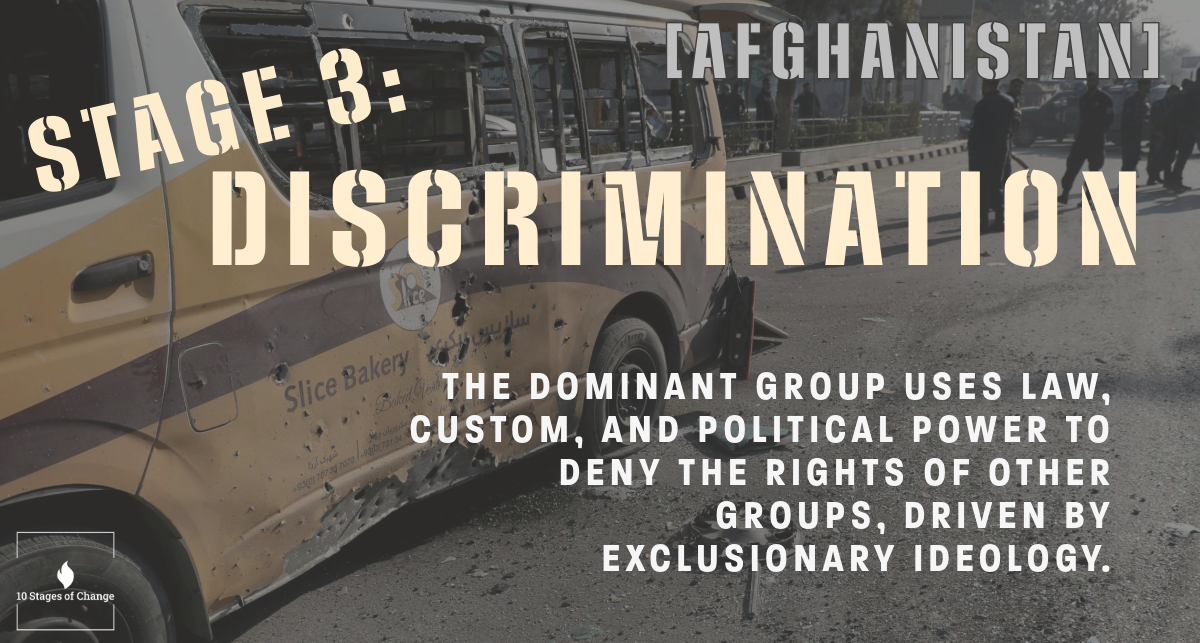
But to echo Emi, and the young poet from Afghanistan at stage three, we don’t passively tolerate denial. We stand up for the million voices — Rwanda, the DRC, Bosnia, Xinjiang — and we face it the way Emi has faced life and death: living and loving deliberately, even in the face of tragedy.
No matter what, we do it anyway.
And this…. this is how it ends.
To learn more about the genocide in Armenia, visit genocideeducation.org.
Thank you for listening. Re-visit the stages at stagesofchange.org.
References
Akçam, T. (2018). Killing orders: Talat Pasha’s telegrams and the Armenian genocide. Palgrave Macmillan. https://link.springer.com/book/10.1007/978-3-319-69787-1
Al Jazeera. (2020, June 29). China forcing birth control on Uighurs to suppress population: AP. https://www.aljazeera.com/news/2020/6/29/china-forcing-birth-control-on-uighurs-to-suppress-population-ap
Armenian National Institute. (n.d.). The Armenian Genocide. https://www.armenian-genocide.org/genocide.html
Armenian Weekly. (2018, April 11). What’s in a name? Artsakh Street, my neighbors, and social media bigotry in Glendale, Calif. https://armenianweekly.com/2018/04/11/whats-in-a-name/
Armenian Weekly. (2018, June 13). Glendale City Council approves Artsakh Avenue renaming. https://armenianweekly.com/2018/06/13/glendale-city-council-approves-artsakh-avenue-renaming/
Armenian Weekly. (2025, July 30). Azerbaijan repeats “voluntary exodus” claim. https://armenianweekly.com/2025/07/30/azerbaijan-repeats-voluntary-exodus-claim/
Armenpress. (2024, January 5). Investigative Committee reveals final death toll of September 2023 Azerbaijani aggression. https://armenpress.am/en/article/1127400
Cambodia Tribunal Monitor. (2009, July 1). Khmer Rouge survivor confronts jail boss. https://www.cambodiatribunal.org/sites/default/files/news/Khmer_Rouge_Survivor_Confronts_Jail_Boss_7_1_09.pdf
CamboJA News. (2026, August). Bou Meng, a S-21 survivor who lived to tell Cambodia’s story, dies at 85. https://cambojanews.com/bou-meng-a-s-21-survivor-who-lived-to-tell-cambodias-story-dies-at-85/
Cambodianess. (2025). Cambodian genocide denial law: The future of Cambodia without genocide. https://cambodianess.com/article/cambodian-genocide-denial-law-the-future-of-cambodia-without-genocide-half-a-century-after-the-khmer-rouge-took-control-over-cambodia-on-17-april-1975
Caucasus Heritage Watch. (2026, May 4). Cultural destruction in Khankendi/Stepanakert. Cornell University. https://caucasusheritage.cornell.edu/?p=2003
European Broadcasting Union. (2025). Sudan’s forgotten war sparks fake imagery. EBU Spotlight. https://spotlight.ebu.ch/p/sudans-forgotten-war-sparks-fake
Genocide Watch. (n.d.). The ten stages of genocide. https://www.genocidewatch.com/tenstages
Hofmann, T. (2021). New aspects of the Talaat Pasha trial. International Journal of Armenian Genocide Studies, 5(1), 67–89. https://agmipublications.asnet.am/wp-content/uploads/2021/03/IJAGS_Vol._5_N1_67-89.pdf
International Court of Justice. (2023, February 22). Application of CERD (Armenia v. Azerbaijan), Order on provisional measures. https://www.icj-cij.org/node/203318
Mahmoud, E. (2016). A young poet tells the story of Darfur [Video]. TED. https://www.ted.com/talks/emtithal_mahmoud_a_young_poet_tells_the_story_of_darfur
Moreno Ocampo, L. (2023, August 7). Expert opinion: Genocide against Armenians in 2023. https://luismorenoocampo.com/wp-content/uploads/2023/08/Armenia-Report-Expert-Opinion.pdf
NBC News. (2025, November 1). Satellite images suggest mass killing in El Fasher. https://www.nbcnews.com/world/africa/sudan-africa-civil-war-rapid-support-forces-el-fasher-massacre-rcna240708
NPR. (2025, October 29). Sudanese American poet talks about the fall of her hometown El Fasher. https://www.npr.org/2025/10/29/nx-s1-5588669/sudanese-american-poet-talks-about-the-fall-of-her-hometown-el-fasher
OC Media. (2023, August 15). First death from starvation reported in blockade-struck Nagorno-Karabakh. https://oc-media.org/first-death-from-starvation-reported-in-blockade-struck-nagorno-karabakh/
OC Media. (2025, November 3). Aliyev says Azerbaijanis must return to “historical lands” — “not with tanks, but in cars.” https://oc-media.org/aliyev-says-azerbaijanis-must-return-to-historical-lands-not-with-tanks-but-in-cars/
OC Media. (2025, November). Exclusive: Azerbaijan’s “Western Azerbaijan” campaign exposed in leaked documents. https://oc-media.org/exclusive-azerbaijans-western-azerbaijan-campaign-exposed-in-leaked-documents/
Public Radio of Armenia. (2023, December 22). Investigative Committee puts the death toll of Stepanakert fuel depot explosion at 218. https://en.armradio.am/2023/12/22/investigative-committee-puts-the-death-toll-of-stepanakert-fuel-depot-explosion-at-218/
RFE/RL. (2021, April 26). Turkey’s Erdoğan slams Biden over Armenian genocide recognition. https://www.rferl.org/a/turkey-erdogan-slams-biden-armenian-genocide/31224125.html
Tom Lantos Human Rights Commission. (2023, September 6). Nagorno-Karabakh update [Hearing]. https://humanrightscommission.house.gov/events/hearings/nagorno-karabakh-update
United Nations. (1948). Convention on the Prevention and Punishment of the Crime of Genocide. https://www.un.org/en/genocideprevention/documents/atrocity-crimes/Doc.1_Convention%20on%20the%20Prevention%20and%20Punishment%20of%20the%20Crime%20of%20Genocide.pdf
United Nations News. (2026, February 19). UN inquiry concludes RSF attacks in El Fasher bear hallmarks of genocide. https://news.un.org/en/story/2026/02/1166997
U.S. Government Accountability Office. (2022). Foreign assistance: Agencies should take steps to improve reporting on assistance to the government of Azerbaijan. https://www.gao.gov/products/gao-22-104619
The White House. (2021, April 24). Statement by President Joe Biden on Armenian Remembrance Day. https://bidenwhitehouse.archives.gov/briefing-room/statements-releases/2021/04/24/statement-by-president-joe-biden-on-armenian-remembrance-day/
The White House. (2025, April 24). Presidential message on Armenian Remembrance Day, 2025. https://www.whitehouse.gov/briefings-statements/2025/04/presidential-message-on-armenian-remembrance-day-2025/
The White House. (2026, April 24). Presidential message on Armenian Remembrance Day. https://www.whitehouse.gov/briefings-statements/2026/04/presidential-message-on-armenian-remembrance-day/
Wikipedia. (n.d.). Assassination of Talaat Pasha. https://en.wikipedia.org/wiki/Assassination_of_Talaat_Pasha
Wikipedia. (n.d.). Blockade of Nagorno-Karabakh. https://en.wikipedia.org/wiki/Blockade_of_Nagorno-Karabakh
Wikipedia. (n.d.). Expulsion of Nagorno-Karabakh Armenians. https://en.wikipedia.org/wiki/Expulsion_of_Nagorno-Karabakh_Armenians
Wikipedia. (n.d.). Operation Nemesis. https://en.wikipedia.org/wiki/Operation_Nemesis
Wikipedia. (n.d.). Raphael Lemkin. https://en.wikipedia.org/wiki/Raphael_Lemkin
Yale Humanitarian Research Lab. (2025). Situation reports and atrocity alerts on El Fasher, Sudan. Yale School of Public Health. https://ysph.yale.edu/hrl/publications/reports/




Leave a Reply