Please Note: The following article contains descriptions and narratives of violence and genocide, as well as an analysis of human behavior relating to sensitive topics, including racism, intolerance, physical violence, and death. Some descriptions and details may be disturbing or upsetting to listeners. Please be mindful of the content before continuing.
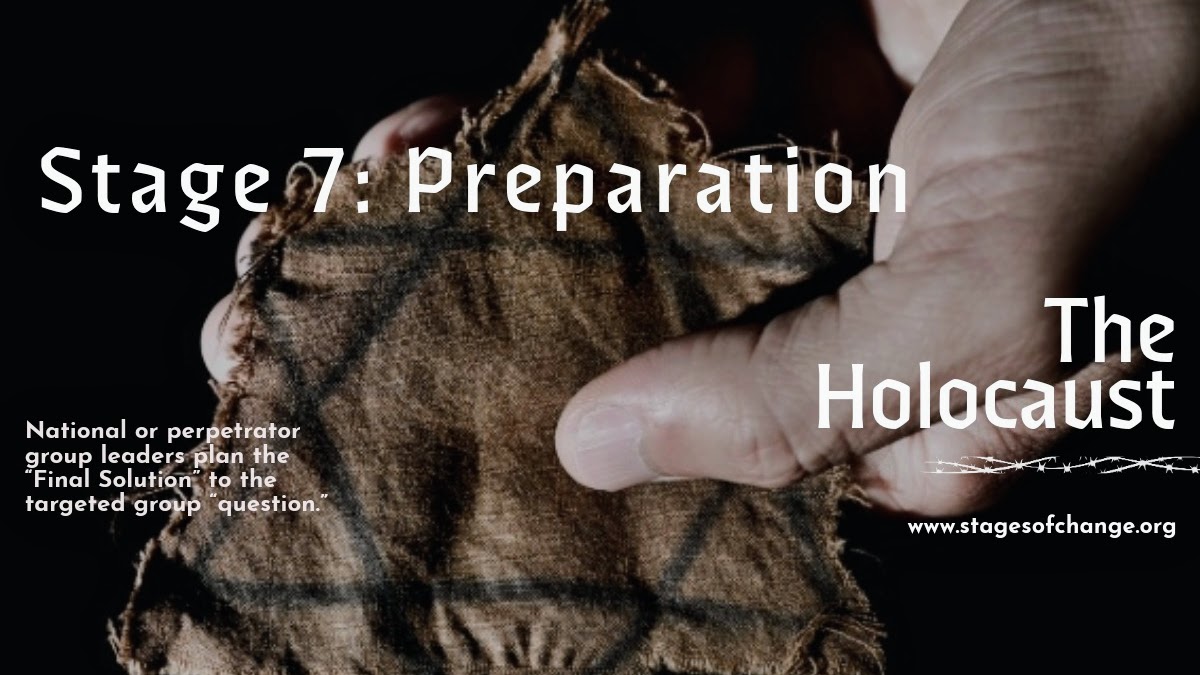
The seventh stage of genocide is preparation. The case study is the Holocaust, where an estimated six million Jews were systematically murdered from 1933–1945.
It is December 1941 in Liepāja, a Latvian port city on the Baltic Sea. German forces have held control since the summer, and registration has already been completed, followed by restrictions that accumulate steadily, so that Jews are counted, marked, and summoned, while notices appear on walls, rules are issued and revised, and men who were present one day fail to reappear the next.
Edward is fifteen years old, with blond hair and blue eyes that will later assume significance he does not yet fully understand.
On documents, his mother becomes someone else; no longer the woman who has lived her life in the city as a Jew but an Aryan foundling, a German child left on a doorstep, baptized, raised by Jews without being one of them, so that her sons, by extension, become half-Jews, still restricted and still vulnerable while subject to a different set of regulations.
Two Latvian women agree to confirm the story if asked. Inside the family’s apartment, preparation becomes practical and repetitive.
The main street in Liepāja before World War II from Yad Vashem
During that same week, the meaning of relocation in Liepāja, Latvia becomes fixed beyond the streets that remain familiar, as the dunes north of the city are repurposed, and at Šķēde Beach, Jews are marched in groups to prepared sites and shot into trenches.
As his family moves through the city, the sea air reaches Edward’s face, and for a moment, a thought enters of how lovely it would be: the sensation of stillness and facing the water.
The Berghof stands above the Obersalzberg in the Bavarian Alps near the Austrian border, removed from urban centers and approached by roads that narrow as they climb. In August 1939, it functions as Adolf Hitler’s private residence and as a place where military authority is exercised outside formal state structures.
On August 22, one week before the planned invasion of Poland, Hitler addresses senior commanders of the Wehrmacht behind closed doors. The meeting is not announced publicly, and no official transcript is prepared for circulation. The officers present are those whose units will carry out the coming campaign.
A version of the speech later reaches the outside world through Louis P. Lochner, an American journalist based in Berlin, who receives the text from a German informant. Portions are later introduced as evidence at the Nuremberg Trials under document numbers L-3, 798-PS, and 1014-PS.
In the address, Hitler frames the coming war in terms that emphasize method and execution, describing victory as dependent on speed and brutality while dismissing concerns about international reaction. Violence against civilian populations is presented as an instrument of policy, justified through reference to historical precedent.
“Our strength consists in our speed and in our brutality,” he tells the assembled officers, invoking Genghis Khan as an example and describing mass slaughter as a method history would later remember only as state-building. He states that criticism will be met with execution and that the aim of the war is the physical destruction of the enemy, carried out by units tasked with killing men, women, and children without distinction.
The response in the room is uneven as some officers remain silent while most applaud. Hermann Göring reacts visibly, rising from his seat and displaying open enthusiasm.
At the conclusion of the address, Hitler poses a question that situates what has been outlined within a longer historical frame. It remains contested in some circles of historical thought, but it serves as a key indicator in the argument for the intentional mass murder of Jews by Hitler.
“Who, after all,” Hitler asks, “speaks today of the annihilation of the Armenians?”
III. Edward Anders. Oral Interview with Randy M. Goldman. February 28, 1997. Cassette One. Side A.
Several decades after Edward Anders left Liepāja, Latvia at fifteen with his mother and brother, he sits with Randy Goldman in 1997 and records around three hours of eyewitness testimony of his experience in pre-war Liepāja, Latvia, subsequent discrimination, imprisonment, and eventual escape.
As a professor of chemistry at the University of Chicago, Anders devoted decades to the study of meteorites and the early history of the solar system, helping to establish the field of cosmochemistry through work that traces sequence and composition from minute samples.
Anders began with documents—assembling court records, depositions, German directives, Latvian police reports, and transport lists produced during the occupation—placing names alongside dates until patterns became visible.
He describes how removal unfolded in stages, as men disappeared first, followed by elderly relatives taken from apartments and grocery lines, while synagogues were dismantled and sacred texts were brought into public spaces.
By December 1941, those who remained were assembled under guard and instructed to report for relocation, before dawn, by design.
His father, Adolf Alperovich, was later shot during the December actions in Liepāja, Latvia.
Shortly after, Anders and his brother were marched to a prison yard where death was imminent.
What follows is extracted from the transcript of Tape One, Side B of Anders’s oral testimony:
“Of course, they were all going to be killed,” Anders says. “So the rest of us then — all of us slowly worked our way toward the prison. As we approached the prison we could see there were similar processions coming from other side streets, always escorted by Latvian police, and into the prison yard. We were one of the last groups to arrive. It was still dark, around seven a.m. or a little before. There was a German policeman reading out lists and he had reached the letter K, I still remember, he was reading the name Katzenelinbogin. Our name began with A, so we had been called quite awhile ago.”
He continues, “And then, a few minutes late was a commotion and we saw that my mother had managed to sneak into the prison yard with another group of Jews. She had first tried to join our group and they wouldn’t take her, she was not on the list. And so, now they knew who she was, she tried joining another group, but she was recognized, she was pushed out of the prison. And then, another couple minutes later, a German policeman appeared, approached us, and with two or three of the Latvian police in tow who had been — who had arrested us. And he asked, what’s your story? And so we showed him our passes and told him. And so he stared at us for about 10 seconds and then suddenly he motioned, go.”
“Now, probably didn’t hurt, all of us were blonde and — and blue-eyed and didn’t hurt that some of my blonde hair was sticking out from under my cap and so I looked sufficiently Aryan, my brother did too. Told us, go. Barely got out on the street, we almost bumped into my mother. She had, having been kicked out of the prison, rushed over to the German police, managed to see some official, I don’t know how high ranking he was, if he was not the top man, and said look what’s happened, my — my sons are half Jews, they’re not supposed to be arrested, and they have been t-taken and can you get them out. And the man was sympathetic, but then he said, what time were they picked up? And she said four o’clock. He looked at the watch, it was seven. Sorry, he said, it’s too late.”
So she thought that if we were dead, then she certainly didn’t want to live and so her only thought was to get back in the prison, join one of the other groups of Jews, and just be killed with everybody else. And suddenly she saw us coming. And during all this to-do, as well, during the arrest and the arguments with the police and so on, we were absolutely calm. I think our mood can best be described as of re-restrained indignation. We were indignant but not to the point of — of shouting or raising our voices, or throwing a fit.
But now all of a sudden we began to shake, and — anyway, the shakes lasted for awhile. We walked home, by the time we got home they were over. My brother had to go to work that day, showed up about an hour late, and I’m not sure what excuse he gave. And so we realized we had survived it.
Later that day I saw — in town, I saw a group of Jews being marched across the bridge north of the city to — to the execution site. And it’s sad sight to realize that here are these people, we had all been arrested together, I got out, but they didn’t. And two months ago I learned in graphic detail what would have happened to me if the policeman had not said go, if he had said stay instead.
And it’s weird when you suddenly sort of get a flashback where you were at this crossroads 55 years ago and you suddenly realize in great detail what would have happened to you if you had gone.
If you had taken the left fork instead of the right fork.”
What follows next is a series of images depicting a story at the edge of Šķēde Beach that echoes dozens of others that preceded it. In September 1941, nearly 34,000 Jews were shot at Babyn Yar over just two days. In later months, an additional 100,000 to 150,000 Jews were murdered there. Babyn Yar’s ravine sits just outside of Kyiv, Ukraine, and locals later testified that the killings were virtually impossible to keep secret, as the sounds of gunfire and the view from many homes allowed direct access to witness the massacres firsthand—many volunteers from Kyiv even took part.
Einsatzgruppen commanders recorded the following statement days after the Babyn Yar massacre regarding the logistics that made it possible:
“The difficulties resulting from such a large-scale action—in particular concerning the seizure—were overcome in Kiev by requesting the Jewish population through wall posters to move. Although only a participation of approximately 5,000 to 6,000 Jews had been expected at first, more than 30,000 Jews arrived who, until the very moment of their execution, still believed in their resettlement, thanks to an extremely clever organization.”
Similar wall posters and commands were described by Anders in his testimony. What makes Liepāja, Latvia unique is the discovery of twelve photographs which tell, in chronological order, the otherwise untold story of the journey from arrival at the ravines and forest areas to the final images of only clothing and valuables lying before a covered mass grave.
The photographs emerged years later through a chain of actions. During the German occupation, a Jewish electrician assigned to maintenance work inside the Security Police building encountered a roll of developed film left unattended in an office. He recognized what the images contained, arranged for the film to be copied, returned the original to its place, and hid the prints. When the Red Army entered Liepāja, Latvia, he contacted Soviet counterintelligence and handed the photographs over. They were transported to Moscow the following day and later entered evidence in war crimes proceedings. Here is what those photos reveal:
In the first frame, Latvian policemen stand several paces away from the people they are guarding, coats buttoned, collars turned up, rifles held loosely at an angle. The cold is evident in their stance. In front of them sit Jewish women gathered closely together, knees drawn in, shoulders angled toward one another, yellow stars stitched to their coats and dresses, visible both on their chests and across their backs. Their faces are turned downward or toward the ground ahead. No one appears to be speaking. Behind them, near the dunes, a German military vehicle is parked—its presence a damning confirmation that German military units (Wehrmacht) were deeply involved, despite later denial.
The next photograph shows the same group after instructions have been carried out. Clothing lies in uneven piles on the sand. Shoes are placed together. Coats are folded or dropped where hands have released them. The distinction between bodies has already begun to shift. Younger women stand or move forward without garments. Older women, children, and the elderly retain some clothing.
In the next frame, a line of young women moves past a row of Latvian policemen. Most are naked. Their arms hang close to their sides or fold instinctively across their bodies. A woman appears to stumble as her weight shifts unevenly. Another woman reaches across and supports her, an arm locked firmly around her shoulders, holding her upright as her head tilts forward. The policemen remain in place. No one steps forward. The distance between those watching and those moving remains unchanged.
The next image draws closer to a single family. Research later confirmed that this was likely the Epstein family of Latvia. A woman bends forward, her face hidden in the crook of her arm, her body folding inward as though bracing against something already known. Beside her stands her daughter, eighteen years old, undressed, her arms crossed over her chest in a gesture that offers no protection and no concealment. In front of her is her younger brother, still clothed, his body turned slightly away, his head angled downward. Behind them, several policemen stand in a loose line, their attention divided among the group. We learn later that pictured is Sorella Epstein, the daughter, and Rosa Epstein, her mother, minutes before their execution.
Epstein Family at Skede Beach Massacre from Public Domain
The father does not appear in the frame. He had been arrested earlier, taken east, and would die months later without learning what happened to his family.
The next photograph widens again. A group is being moved forward together. At the front walks a boy wearing a dark shirt. His posture is rigid. His head is turned to the right, and his face holds an expression of disbelief and anguish, as though whatever he is seeing has not allowed him time to look away. Behind him, a small girl has stopped. She has turned back toward her mother and grips her clothing with both hands. The mother bends toward the child, her face close to the girl’s head, her mouth positioned as if speaking. Another woman carries a baby on her shoulder. The infant’s head rests heavily against her neck, its body slack with the unknowing weight of sleep or distraction. We still do not know what the children see.
The Skede Beach Massacre from Public Domain
The following frame, however, shows what is to the right.
Ten women stand at the edge of a trench, aligned along the far side, facing the sea. The ditch between them and the shooters spans several meters, its depth visible where the sand falls away. One woman leans heavily into the woman beside her, her body no longer maintaining itself, her weight transferred fully, as if the effort of standing has ended. The woman beside her remains upright, receiving the weight without shifting her own position. The others stand facing forward.
This is what the boy sees.
Beyond them, the water stretches outward, flat and pale, the breeze pushing past their bodies, the world standing still, silent.
By the next frame, they are gone.
Just before the Wannsee Conference took place in January 1942, Einsatzgruppen commanders reported that as of the end of 1941, the occupied territories to which they were assigned were at last designated Judenfrei:
In the southwestern edge of Berlin, the district of Wannsee stretches along two lakes whose surfaces in winter hold light without movement, bordered by paths and villas that in warmer months draw swimmers, sailors, and families from the city , while in January 1942 the air remains still, the lakes sealed beneath ice, snow hardened and trees glazed.
At Am Großen Wannsee 56–58 stands a villa designed for leisure and private transaction, its pale façade and balanced proportions shaped by money accumulated over decades—a house meant for contracts, meals, and extended conversation among friends and colleagues. Built for the industrialist Ernst Marlier and later owned by Friedrich Minoux, who sold it to the SS in 1941 after his imprisonment for fraud, the structure remains largely unchanged, its rooms adapted to a new function without renovation, their familiarity left intact. (House of the Wannsee Conference Memorial)
By midday, men arrive from across the Reich ministries, coats carrying traces of snow as they move through the entryway and place their belongings alongside one another, exchanging greetings before taking their seats around a long table. Coffee has been poured and left to cool, and a stack of typed pages rests within reach, clipped at the corner, listing fifteen names and offices arranged according to an internal hierarchy, representing the Reich Chancellery, the Reich Security Main Office, the Foreign Office, the Justice Ministry, the Interior Ministry, the Office for the Occupied Eastern Territories, and the Party Chancellery—each position occupied by a man whose authority is defined by jurisdiction.
The invitations that brought them here had been issued less than two weeks earlier, their language brief and procedural:
“I therefore invite you to a conference, to be followed by breakfast, on 20 January 1942 at 12:00 hours, at Berlin, Am Großen Wannsee 56–58.”
Wannsee Conference – Letter from Reinhard Heydrich to Martin Luther (Invitation) from WikiMedia Commons
Signed by Reinhard Heydrich, SS-Obergruppenführer, the letter contains no reference to killing, camps, or shootings—only the expectation of attendance and participation.
Once assembled, the meeting proceeds with Heydrich speaking from the head of the table, stating that responsibility for the central handling of the “Final Solution of the Jewish Question” has been placed with the SS and the German Police—a declaration that reorganizes authority across departments and binds it to a single chain of command.
The discussion moves through material already familiar to those present, as existing measures are reviewed, responsibilities clarified, and definitions standardized, with particular attention given to legal categories that determine inclusion, exemption, or temporary deferral. Degrees of Jewish ancestry are examined with precision, and deportation is addressed as a logistical matter requiring coordination among ministries, occupied territories, and transportation systems already operating under strain.
As documents are consulted and figures recalculated, a total is presented:
“Here now the number of Jews still living in Europe.”
The minutes record the figures and the jurisdictions, note the agreements reached, and close with a list of names. One entry reads simply:
Meanwhile, the goal of creating territories that were Judenfrei was closer than ever. The final stages of preparation had arrived.
After the meeting at the Wannsee Villa concludes, the minutes mark approximately two hours: two hours of euphemisms, some arguments, awkward glances—but ultimately, the participants leave in small groups, returning to offices where their responsibilities resume under structures already in place. Bureaucracy continues.
Next, the protocol is typed, copied, and distributed as sparingly as possible. The construction of extermination camps—under no guise of labor or detention—was underway.
Chelmno would prove that gassing was effective; Zyklon B would later substitute carbon monoxide after the establishment of Belzec and Sobibor, camps consisting solely of gas chambers and crematoria, beginning the industrialization of killing—the culmination of years of process and preparation.
Subsequent correspondence refers to the phrasing used in the Wannsee minutes. Transport requests cite its categories, and deportation orders repeat the same terms agreed upon at that table.
1.7 million more Jews would be murdered in Treblinka, Belzec, and Sobibor—on top of the 1.5 million already killed by the Einsatzgruppen.
VI. Preparation and Process
If there is a distinct coldness felt in the seemingly mundane speeches and descriptions conveyed at Wannsee, at the Obersalzberg, or in the directive of Jews marching toward their fate at Šķēde Beach, this is not accidental.
Resembling, in many ways, the coldness of the organization stage of genocide seen in Myanmar, preparation operates and depends on a similar compartmentalization—from persecutors, collaborators, and even bystanders. Eventually, this compartmentalization begins to blur the lines between personal responsibility and collaboration with state duty and organized instruction. Intention becomes impossible to ignore at this point. We have entered the final, and most deadly, stages of the genocidal process.
Unfortunately, this is where much Holocaust education begins.
Simplistic Holocaust Education Outcomes from Chalkbeat
The narrative often goes like this: Germany lost World War I. Jews were blamed because it was easy. Hitler came to power with ease, and he and the Nazi Party had the support of vengeful Germans who hated Jews. Jews faced discrimination and exclusion and were put in ghettos. At some point, they were moved to concentration camps on cattle cars—almost always Auschwitz, the only camp many can name, if they can name any at all. Jews were gassed or worked to death and burned. American and British troops liberated the camps and saved the day. Jews found justice at the Nuremberg Trials. End of story.
However, we do a great disservice to our youth—and to ourselves—by accepting this simplicity.
The simplicity of the narrative above ignores the excruciatingly long history of antisemitism, the complicity of neighbors, the complexity of “Jew” and “half-Jew,” the contradictory roles played by both persecutors and the persecuted, and perhaps most importantly: the evolution of the Holocaust as a process, not a series of isolated or sequential events.
To understand the Holocaust as an evolving process—not an inevitable one—we can look at preparation as defined by Gregory Stanton in his Ten Stages of Genocide framework. He writes:
“National or perpetrator group leaders plan the ‘Final Solution’ to the Jewish, Armenian, Tutsi or other targeted group ‘question.’ They often use euphemisms to cloak their intentions, such as referring to their goals as ‘ethnic cleansing,’ ‘purification,’ or ‘counter-terrorism.’ They build armies, buy weapons and train their troops and militias. They indoctrinate the populace with fear of the victim group. There is a sudden increase in inflammatory rhetoric and hate propaganda with the objective of creating fear of the other group.”
And so, perhaps, we should begin at Wannsee. It is there, after all, where the “Final Solution” to the Jewish question was most explicitly described, as preserved in the written record. And yet, this remains insufficient.
The plans set forth in Wannsee were undoubtedly a turning point. The records provide a rare and chilling glimpse at what had been inferred well before the deportations began. We can see the euphemisms Stanton refers to—“evacuated to the East,” “in the appropriate manner”—phrases that concealed systematic murder in bureaucratic code.
But just as the Wannsee Conference took place, it’s crucial to note that nearly a quarter of the deaths in the Holocaust had already occurred—before Treblinka, before Sobibor, before even Chelmno, where the process of gassing was first “fine-tuned.” There was what has been called the “Holocaust by bullets.”
These 1.5 million deaths were the culminating consequence of years of discrimination, propaganda, and polarization. The murders were largely carried out by the Einsatzgruppen—mobile killing units made up of SS soldiers and police whose primary goal, at the onset of Operation Barbarossa and the invasion of Poland, was to make occupied territories Judenfrei—free of Jews.
Perhaps more distressing, however, is that they often enlisted the help of each town’s everyday citizens, willing and ready to shoot their Jewish friends and neighbors—people they had known, in some cases, their entire lives. Worse still, there were individuals who did not need to be “enlisted” at all, despite later claims that they had been coerced. Many helped round up the town’s Jews, herd them to nearby forests and ravines, and oversee the massive task of digging their own graves.
In the Baltics, Latvian auxiliary police units became particularly notorious for their brutality.
In this Holocaust by bullets, there are no cattle cars yet. There are no gas chambers, no death camps for the sole purpose of mass murder—and yet few people know of the Einsatzgruppen at all, much less that they had already killed so many.
This played a crucial role in the preparation stage of genocide, as it depended not only on the special killing squads but on the participation of local collaborators driven by antisemitism and promises of prosperity through propaganda.
Meanwhile, a series of experiments had begun to show promise. It involved herding prisoners into sealed vans, promising transport or relocation, and filling the van with carbon monoxide gas—killing efficiently, wasting fewer bullets, and sparing the perpetrators from direct gunfire.
At the same time, railroad lines were studied. The idea of forcing Jews eastward by train and implementing a scalable system of gassing seemed increasingly feasible.
This, then, is preparation as process in action. Some argue that this process was intentional from the start; others argue that each new progression arose opportunistically, as function dictated form.
Regardless of intention, preparation became the language of execution. Soon all Jews would be liquidated from ghettos and “evacuated to the East.” They would leave behind the things they couldn’t carry—diary pages, photographs, dolls, crafts, sacred texts, suitcases with hidden bread, and the dead.
Krakow Ghetto, Post-Liquidation Belongings Remain by Public Domain
As gas was being accepted as the most “innovative” method for solving the so-called Jewish question, the Einsatzgruppen had largely fulfilled their duties, paving the way for the next phase of annihilation.
VII. Edward Anders. Oral Interview with Randy M. Goldman. February 28, 1997. Tape 3, Side B.
When Anders speaks about the period before December 1941, the idea of expectation continues to arise—that is, a set of assumptions built up over years and tied to human nature itself. His family listened to the BBC; they read foreign newspapers; they knew Jews were being excluded, deprived of rights, and pushed out of public life. And yet none of this, he explains, translated into an expectation of death.
This sense of denial echoes through several testimonies, but one can’t help thinking of Elie Wiesel’s Night, in which fifteen-year-old Wiesel arrives at Auschwitz and describes the horror of what he realizes he has walked into:
“Can this be true?!” he says. “This is the twentieth century, not the Middle Ages. Who would allow such crimes to be committed? How could the world remain silent?”
In Anders’s testimony, he continues:
“It’s a shame that it happened,” he recalls thinking of Kristallnacht, and early reports of violence, “but somehow we weren’t prepared to change my family’s and many other Jews’ perception of the Germans being basically fair.”
“They were very strict with Jews,” he says, “they were depriving them of some civil rights, but we didn’t believe any of this.”
What Anders describes, however, is built on human precedent—where discrimination has limits, states operate within rules, and punishment, if it came, would be selective. Perhaps, too, there are elements of self-preservation at work. Even when the war began, that framework held.
“In my family, out of twenty-seven people, only two fled,” he explains. “The others all stayed, which means they felt that the Germans were the lesser evil.”
This assumption—that brutality would remain bounded—was very much anticipated and exploited by persecutors.
“People grasp at straws in such situations,” Anders says. “There were occasional rumors that somebody had traveled along a country road and passed a huge camp with lots of Jews working there. What they were doing… pure invention.”
“One day,” he recalls, “a German sailor stood there and struck up a conversation… He said, ‘Oh, you have a lot of Jews in your town.’ And then he made a movement of this trigger finger.
You show a poker face,” he says. “It would be disastrous if you made a long face.”
“I don’t know if anybody else survived,” he says again near the end of the interview.
Goldman asks:
“Have you thought about what sorts of long-term impact these experiences have had on your life—on the way you’ve lived it, raised your kids, or just on your personality?”
Anders replies:
“I think it has taught me not to generalize about people, and there are really two factors that pushed me in that direction. One of them was that before the German occupation, we thought that just because my father was a very decent businessman—he had some letters from his German customers commending him for having warned them about unfair practices of some other businesspeople—that no matter what complaints the antisemites had about certain Jews, my father had an excellent record and would be treated accordingly.
But they didn’t. They treated everybody the same, regardless of what you’d done as a person.
And similarly, I’ve learned that there were some awful Germans, some monsters, and there were some angels, and lots in between. The same with Latvians. I began to realize that it’s absolutely wrong to generalize.
I don’t like to say ‘the Germans,’ or ‘the Jews,’ or ‘the Latvians.’ I tend to view people as individuals.”
Edward Anders with Autobiography from Public Domain
The tape stops rolling, and Tape 3, Side B ends.
VIII. Preparation and Antisemitism
Preparation is the stage at which genocide becomes administratively possible—when violence no longer depends on secrecy or improvisation but moves instead through systems that already exist and continue to appear intact. Meetings are held and recorded, documents circulate between offices, legal categories are refined and narrowed, and transport is discussed in terms of feasibility and coordination.
What distinguishes preparation from earlier stages is not just escalation but normalization, as language shifts toward procedure. By the time preparation is visible, prevention is already constrained, since the machinery has been assembled, authority assigned, and categories agreed upon in ways that leave little room for reversal.
And yet, this stage remains essential to study because it exposes where intervention failed earlier—how warning signs were absorbed into daily practice, and how similar structures continue to operate in the present, often unnoticed, until their outcomes become impossible to ignore.
That isn’t to say that prevention is irrelevant, but rather that we must shift our thinking: from preventing preparation itself, to preventing the signs of preparation as they emerge early on. We can revisit the earlier stages and continue the actions against classification, symbolization, dehumanization, and discrimination. And we can teach what leads to preparation—and, more solemnly, what follows it—as both a warning and a reminder of what inaction can lead to.
Accordingly, there are still actionable steps we can take to spotlight genocide as it unfolds in its final stages, demand accountability, and prevent escalation before it occurs.
The following are actions you and your community can take immediately to make this a reality:
Put early-warning risk on your calendar. Subscribe to the Early Warning Project run by the United States Holocaust Memorial Museum and add a reminder to read each update when it arrives. These brief reports flag countries where mass violence is becoming likely before killing escalates.
Learn how hate disguises itself today, not just historically. Spend fifteen minutes on the ADL Hate Symbols Database or Extremism Glossary. Preparation relies on language that sounds administrative, patriotic, or “reasonable” until it is no longer optional.
See what documentation looks like before trials exist. Read a current investigation by Bellingcat that uses satellite images, videos, or leaked documents to establish civilian targeting or forced displacement. This is how preparation is recorded while it is still unfolding.
Listen to a survivor speak without interruption. Watch a full testimony from the USC Shoah Foundation archive in its entirety to understand how gradual erosion of rights affected individuals differently, and how choices, particularly of bystanders, either helped or worsened this erosion.
Correct misinformation calmly in your immediate environment. When you hear claims that genocide “comes out of nowhere” or that warnings are exaggerated, respond with a specific historical example you already know—Bosnia, Rwanda, the Holocaust. No debate is required. Preparation depends on disbelief going unchallenged.
Learn how antisemitism operates. Explore Antisemitism Today, a free course from Facing History & Ourselves. It focuses on modern political and cultural forms of antisemitism—not only historical stereotypes—and examines how antisemitism takes shape on social media.
Pay attention to paperwork, not solely violence. Notice who is suddenly required to register, report, relocate, re-document, or lose access to housing, healthcare, education, or employment. Preparation appears first as forms, lists, and policy changes.
Support displacement response before displacement becomes mass death. Volunteer or donate to a refugee resettlement agency or the International Rescue Committee. Forced movement is a preparatory act even when framed as “temporary” or “logistical.”
Name preparation when you see it. Use the word preparation when describing coordinated discrimination, forced relocation, or administrative targeting. Avoid euphemism. Precision slows normalization.
Understand that at late stages of genocide, it is often too late to act. Therefore, we must collectively make our voices heard before atrocities worsen.
Recall the children being led across the beach at Šķēde, where a woman cradled her baby and a boy in a dark shirt stepped over mounds of sand, his head turned, grimacing at the sight before him.
The frame changes. They are at the edge of the dune.
The boy steps forward when his turn comes. He has already seen the women at the edge and understands what the arrangement means, so what remains is only the short distance across the sand and the stillness required at the end of it.
He stops where he is directed. The trench lies in front of him, close enough now that he does not look down. His attention lifts instead—past the line of bodies and the men standing opposite—toward the water beyond.
A bird crosses his vision, low and steady, and his mind follows it without effort, registering the openness ahead, the simple fact of standing there, facing outward, thinking how lovely it would be to face the sea.
In Memoriam.
Shortly after research for this article was already underway, Mr. Edward Anders passed away on June 1, 2025, in San Francisco, three weeks before his ninety-ninth birthday. He was the last survivor from the Baltic city of Liepāja.
You can read his obituary and access information about his autobiography through this article’s linked sources. His full oral testimony with Randy Goldman is preserved in the archives of the United States Holocaust Memorial Museum.
Rest in peace, Mr. Anders, and may your story continue to serve as both an inspiration and a warning for generations to come.
Gedenk- und Bildungsstätte Haus der Wannsee-Konferenz. (n.d.). House of the Wannsee Conference Memorial. Retrieved December 27, 2025, from https://www.ghwk.de/en/


.JPG)
Leave a Reply