
Please Note: The following article contains descriptions and narratives of violence and genocide, as well as an analysis of human behavior relating to sensitive topics, including racism, intolerance, physical violence, and death. Some images and details may be disturbing or upsetting to readers, including graphic imagery. Please be mindful of the content before continuing.
Visit Mental Health America’s site for information on mental health, getting help, and taking action.
Introduction
The following is part of a series of blog posts concerning genocide and the ten stages of genocide outlined by Gregory H. Stanton. The purpose is not only to raise awareness of the multiple genocides from the past and the present but to provide a set of actions within realistic time constraints that you can take immediately to promote change, prevention, and tolerance. Each week covers a different stage of genocide, with a specific country or region in focus that has or is currently experiencing genocide. It concludes with an analysis of how that stage is or was evident in the featured genocide and what actions can be taken specifically to work against it.
Polarization is the sixth stage of genocide.
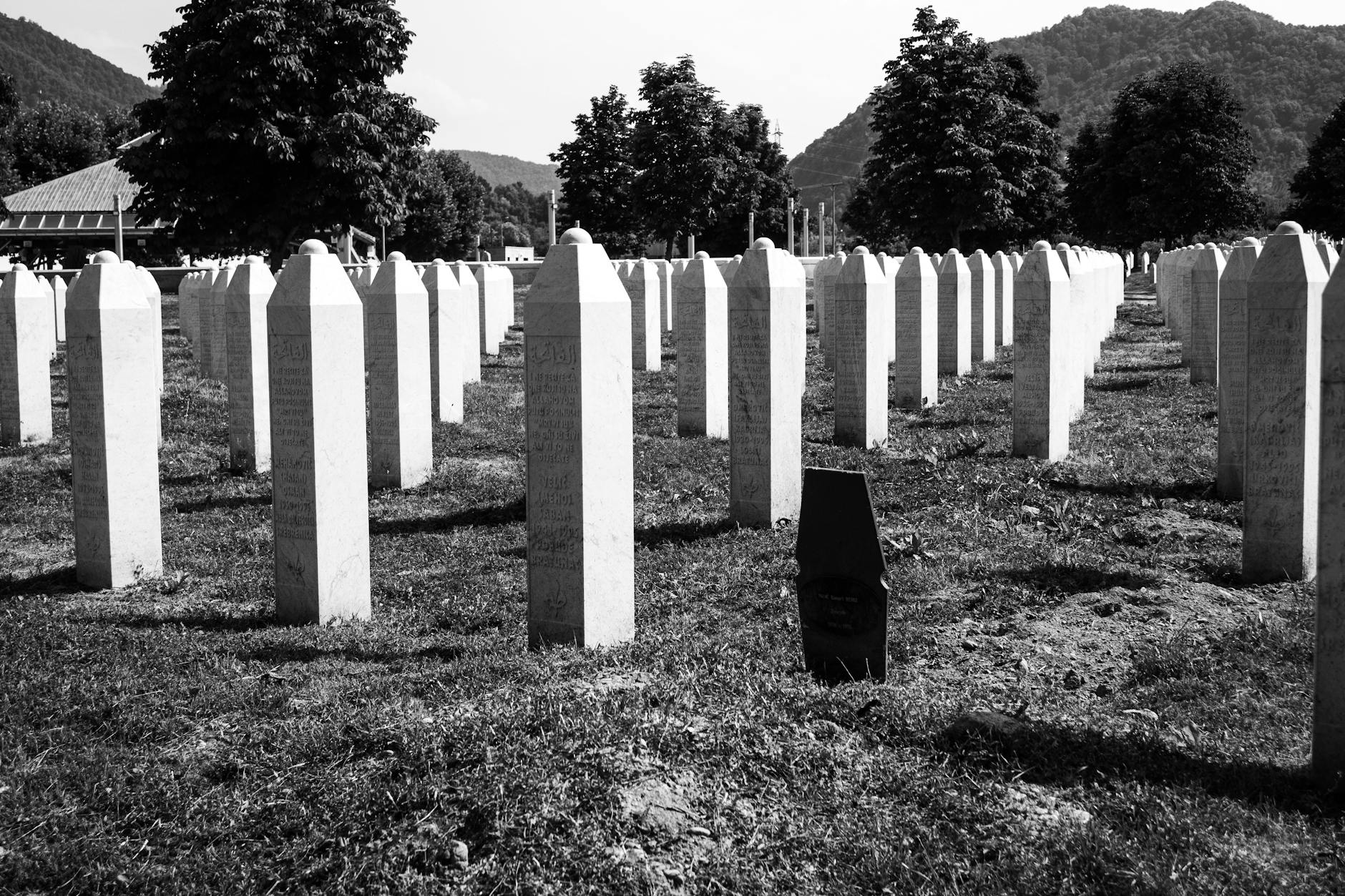
The case study is Bosnia & Herzegovina, where ethnic cleansing and war crimes took place between 1992 and 1995, and where genocide took place in Srebrenica between July 11, 1995 and July 16, 1995.
I. Dragica Ednes. Razanj Refugee Camp, Serbia. 1994.
Serbia is not home for Dragica “Aunty Draga” Ednes.
You feel it the second the UNTV tape starts rolling. Through the grain of a 90s camcorder, she balances herself on a metal fold-out chair in a weed-choked yard, an unfolded letter trembling in her hand. Clotheslines sway behind her; Brutalist style dorm blocks loom above a singular tree; somehow a sense of urgency is immediately apparent. A message must be read.
Her large, oversized glasses, sky-blue blouse, and silver hoops clash with the sterile emptiness surrounding her.
It is 1994.
Two years have passed since Draga fled Mostar, a medieval village in southern Bosnia and Herzegovina split by the Neretva River. For four centuries the 16th-century Stari Most (“Old Bridge”) joined east and west and served as both a symbolic and literal bridge bringing together two cultures. Croatian shells destroyed it on November 9th, 1993; by the time of Draga’s recording, the bridge – and the pluralism the city once prided itself on- lay in ruins.
Mostar’s fate, like that of virtually every piece of Bosnia and Herzegovina and its surrounding territories, was bound to the unraveling of Yugoslavia. Once a socialist federation made up of Slovenia, Croatia, Bosnia and Herzegovina, Serbia (with Kosovo as an autonomous province), Montenegro, and North Macedonia, it began to fracture in 1991 and 1992 as nationalist leaders drew new borders in response to a domino-like effect of disintegration. Belgrade armed Bosnian-Serb forces who were committed to building what they called a “Greater Serbia,” while Bosniak and Croat units first fought together, until between late 1992 and March 1994, when they turned against each other before the Washington Agreement re-allied them against the Serb army.
What followed: expulsions, camps, and distrust that culminated in the Srebrenica massacre in July of 1995. It is impossible to grasp the full scope of Srebrenica’s genocide, however, without taking fully into account the micro and macro-level losses that resulted from the breakup of the once-unified Yugoslavia. Survivors mourn not only the dead but the vanished ease of neighbors who once shared coffee, weddings, and holy days. Former President Josip Broz Tito had (however odd the wording may sound) enforced strict unity, particularly under the slogan “brotherhood and unity” in Yugoslavia. However, his death in 1980 gave way to an underlying reality and hard-line nationalism rushed into the vacuum.
So here sits Draga—herself a Bosniak—in Ražanj, far from the Neretva, holding a letter to her best friend. She reads it to the camera, letting words stretch like a new bridge across a gulf that war insists should be permanent.
Her letter is addressed to Nada, who made the decision to stay in Mostar throughout the war. For Draga, a Bosniak, it was not a choice she could be afforded. The caption of the UNTV clip sets the context: After two years of fighting, Mostar is now a divided city, with a Croat controlled half and a Muslim controlled half.
She begins:
‘My dear Nada,
It’s Dragica speaking. You know that I am not in Mostar, and wherever I am, I don’t feel fine and it cannot be nice. Is Neretva still there, where it used to be, Nada? Have a look at it for me, Nada, and throw a flower into it, instead of my glance. The Old Bridge is for me as it used to be, although it doesn’t exist anymore….After war we are left with nothing and then we start from the beginning again. Does all this make any sense? Two months after I left Mostar, here in Serbia, I made a decision.
I am leaving the Balkans.
Nada, I am leaving full of faith. Full of faith in people who are staying in Mostar. You know how we were brought up: no religion, no nationality. My grandfather used to say: ‘A friend is a friend, no matter what religion he is.’
We were friends with everyone, we accepted everyone, we lived happily. We must preserve this, Nada. I am preserving that special, Mostarian openness to love everyone. Religion is not important, nationality, origin – we are all human beings.
Maybe somewhere these qualities are still important.
Maybe somewhere these qualities are still appreciated.
Maybe somewhere.’

II. Refik Hodžić. Panel No. 3. First Conference on the Legacy of the International Criminal Tribunal of the Former Yugoslavia. Sarajevo, Bosnia. Holiday Inn Sarajevo.
November 6, 2012.
The papers that carried Draga from one checkpoint to the next were still creasing in her pocket when, far away, diplomats lifted their hands for U.N. Security Council Resolution 827, long before 2012. The resolution was a response to the ongoing violations of humanitarian law during the larger Yugoslav Wars, and eventually mandated the prosecution of perpetrators of genocide and crimes against humanity. To this day, despite its shortcomings, the resolution marked a major development in international criminal justice. A message became clear: Impunity was no longer accepted as the norm.
In 2012, the Tribunal came together again, for a reflection on the legacy as the end of the mandate to prosecute war criminals was close to its end.
The conference room at the Holiday Inn Sarajevo is filled with a low murmur of simultaneous translation and the rustle of folders stamped with UN logos. Refik Hodžić, journalist and former outreach officer for the tribunal (ICTY), stands at the podium, overlooking a crowd that includes mothers from Srebrenica, international lawyers, and a handful of teenagers in the back row, slouched in their seats. The audience is, somewhat surprisingly, exceptionally diverse.
This makes sense, as Panel No. 3 was titled “The Future of the Past,” with its aim to bring attention to education, memory, and reconciliation specifically. The conference organizers had a straightforward goal: to pass down historical truth to a generation too young to have ever experienced the Yugoslav Wars firsthand.

The city outside serves as a living museum of sorts: dotted with bullet holes, littered with rubble; but the streets are alive again, and the bridge over the Miljacka (the Sarajevo version of Mostar’s treasured Neretva) is again crowded with tourists. But inside the Holiday Inn Sarajevo, there is a heaviness. Had the Tribunal done anything to heal the country’s wounds? As the tourists take family photos outside, the question remains open inside.
At the podium, Refik doesn’t read from his notes. He speaks slowly, sometimes pausing to let his words settle.
“We believed, or wanted to believe, that if the facts were established, if the crimes were named and recorded, that would be enough,” he says, before pausing and looking across the crowd. “We thought the truth would be a bridge.”
He glances at the audience again, his eyes meeting the women in headscarves, the young men in suits., the teenagers with their shirts untucked.
“But the truth, it turns out, is only as strong as the hands willing to carry it.”
He recounts moments from the Tribunal’s history: the first time a survivor from Prijedor described the lists, the buses, the silence in the gymnasium they were forced into; the day the verdict was read in the Tadić case, and the press room erupted in arguments over what justice looked like. He remembers the way witnesses would sit, hands clenched, sometimes refusing to look at the accused, sometimes refusing to look at anyone at all.
He remembers the way the accused would stare straight ahead, unmoved.
“We have a record now, thousands of pages, names and dates and orders signed. But outside these walls, in the schools, in the news, in the stories people tell their children, there are still many truths. In some places, the verdicts are denied. In others, they are used as proof that only one group suffered.”

He pauses, then asks the room a critical question: “Can you foresee a future in which the facts established before the Tribunal are accepted as such, and made part of the school curriculum?”
No one answers. Someone coughs, seemingly purposeful to shield the silence. A woman in the front row wipes her eyes.
He continues, “Polarization was not just a wartime tactic. It is a habit now, a way of seeing the world. The Tribunal was supposed to be a mirror, but too often it has become another line drawn between us.”
He closes his folder, steps away from the podium, and the conference moves on to the next panel. But the question lingers in the air, unanswered.
III. Witness DD. Trial of Radislav Kristić (MICT-13-46). ICTY Courtroom. The Hague. July 26, 2000.
III. Slobodan Milošević. Channel 4 News. June 1992.
In 1992, Bosnian Serb soldiers identified a key target in their determination to take control of large parts of Bosnia and Herzegovina:
Srebrenica.
The planned takeover of Bosnia as a whole which preceded the concentrated massacre in Srebrenica – a finale to years of suffering by Bosnian Muslims – was awkward at best, and its execution disastrous. It started with the breakdown of Yugoslavia as countries seceded from a failing union that once was: a mix of bankruptcy due to negligible prosperity as prices and salaries both increased, and an overall feeling of uncertainty and lack of unified identity, followed with politicians who saw this as ripe for exploitation, where the best way to convince a population to pledge allegiance and gain control is to divide them.
And that’s exactly what was done.
For context, in 1989, the aggressively ambitious Serbia had a new leader: Slobodan Milošević. He only appears unassuming at first. Shortly after gaining power, he made clear an ambitious vision: a new Serbia with equal rights for all. He spoke passionately of this in a 1992 interview, claiming “his people,” the Serbs, suffering a mostly imagined threat living in Bosnia among Bosniaks (ethnic Bosnian Muslims) who he claimed were terrorizing Serbs in Bosnia and Herzegovina, as Bosnia finally had declared its independence from Yugoslavia in March of 1992 and formally seceded a month later. Bosnian Serbs boycotted the secession.
Two months after the interview, an investigation obtained the first footage of concentration camps in Bosnia and Herzegovina set up by his own Serb forces.
Ethnic cleansing grew between 1992 and 1995, with forced displacements, detentions, and murder committed under Bosnian Serb control. Bosnian Serbs preferred to call the deportations “evacuations.” Serbs fully believed that that Bosniak inhabitants must be eliminated.
The United Nations, upon their slow admittance that a humanitarian nightmare was taking place, kept roughly 200 Dutch peacekeepers stationed near Srebrenica. One detail was ignored in this plan: They were not authorized to use force to defend the Bosniaks they were sent to protect. Peace attempts failed, NATO was consulted for help, and apparent safe havens under a “no fly zone” were clumsily established.
On July 11, Bosnian Serb forces, led by Ratko Mladic, casually advanced through Srebrenica, and in a statement recorded on a film similar to Draga’s in the Serbian refugee camp she was forced into just years earlier, states, “The time has come…to take revenge on the Muslims.” Killings began the evening of July 12th as Bosniak men fled through surrounding forests for safety, many later tricked into surrendering under false promises of UN safety while women and children were loaded on buses and taken to Bosniak territory.
On July 13, killing accelerated. Men were taken away, blindfolded, executed along the Drina River, in warehouses, along football fields, next to meadows and in ravines, cultural centers and dirt roads. The mass graves discovered later revealed that victims’ arms and feet were bound, with many bodies mutilated.
In total, 19,473 Bosnian Serbs were implicated in the massacres in Srebrenica, and most continued to hold government positions after the war.
Over 8,000 Bosniak men and boys were murdered in Srebrenica alone.

With a tribunal already established, it didn’t take long, however, for more than 20 high ranking perpetrators to be indicted. After his arrest in 1998, the trial for Radislav Krstic began. He served as the commander of the Bosnian Serb corps and was accused of aiding and abetting genocide.
Krstic himself describes a childhood in which community was “heterogeneous,” unified, and tolerant of one another’s differences. It is the same sentiment of every person – perpetrators included – within Bosnia and Herzegovina. The words are always the same:
“We were so unified. How could this happen? It was never supposed to be this way.”
Throughout his trial, he describes Yugoslavia’s diversity and ethnic differences as a spiritual uniqueness that was cherished.
But just as there is “Bosnia before” and “Bosnia after” so distinctly in the country’s collective consciousness, so too was there Krstic before and after. His military position after deciding to settle in Bosnia where he was born, grew substantially, until he joined the Army of Republika Srpska – the Bosnian Serb army., shortly after. It was then that for the first time, he described in his testimony, existing within an “ethnically homogeneous” community made up exclusively of ethnic Serbs within Bosnia territory. Although his officers were inexperienced at first, they improved quickly, allowing battles in 1993 and 1994 to end victoriously for Serbs as Bosnian Muslims continued to be “evacuated.” Moreover, the “safe zones” over Srebrenica, he decided, would be a base for operations.
Unfortunately, Bosnian Muslims hid their own solders and weapons there as well. Opportunity presented itself in this case, and thus commenced the order to kill all Bosnian Muslim men and boys. The attempt was disturbingly successful.
It’s July 26, 2000, and she’s been called as a witness in Krstic’s trial.
The following is extracted from the transcript documents and footage of the court examination of Witness DD on Wednesday, July 26, 2000, condensed for brevity but otherwise unedited:
9:37 a.m.
The witness entered court.
The accused entered court.
JUDGE RODRIGUEZ: We are going to resume our case. Good morning, madam. Can you hear me? I didn’t hear an answer. Can you hear me? Yes, I’m in front oF you. I’m talking to you.
THE WITNESS: Yes, I do hear you.
Witness DD. (A)
Examined by Ms. Karagiannakis (Q)
Q. Can you tell me what your nationality is and what your religion is?
A. I am a Muslim woman.
Q. You had four children. And what was your job or role?
A. My role was to be a faithful housewife, to work hard, to take care of the household and its needs, to look after the children, to do the housework and the farming and the land, everything that was necessary.
Q. Now, did you have any Serb neighbours?
A. We did.
Q. And were they aware of the way in which your family and other Muslim families were organised in your village?
A. Yes, they did know. We were friends, in fact. We went to have coffee at each other’s houses. And if we were working on something, we would help one another. We would help them, and they would help us.
Q. In general, how would you describe your standard of living at that time?
A. How can I describe it? It was a kind of life one could only hope for, the kind of life we had before the war. One had one’s own land. You could produce what you wanted: vegetables, fruit, tend livestock, dairy products, everything. Whatever you needed, you had everything. My husband was working in a public company. He brought home his earnings. All we had to do was enjoy life.
Q. Now, Witness, I’d like to focus your attention on the events in Srebrenica in July 1995. At that time the attack on Srebrenica started, were you living with your husband and your sons in your home about three kilometres from Srebrenica town?
A. Yes.
Q. And when the attack commenced, did you and your family leave your home to go into the woods because shells had fallen near your house and you feared for your safety?
A. Yes….My husband threw one by one of us out of the house to the right. There was a bit of shelter there, and he said run into the vale that was below the house to take shelter. And he helped one child after another get out of the house, and then me. I was screaming. I grabbed him; I didn’t want to go without him. He said, “You go and I will follow.” I turned around. There was a line with clothes hanging out to dry. I grabbed some things because the children had nothing on. And so we ran through our own fields that were sown with wheat and maize, and we ran and ran and the shells kept falling….We sought shelter, but there was a lot of people there, so there wasn’t enough room. And it was terrible.
Then we got to Srebrenica.
You would think the whole world was there.
At that point, the shelling started again. The detonations were so loud, one would think that the whole earth was on fire. Somebody shouted out, “Nobody is ever going to come and save us.”
At that point I told my husband for the last time, “We’re no going to separate ourselves,” and he told me not to worry. He told me to take two of our children and leave, and he said that he would join other men. But as we were talking, we could see that the shells were falling. So we parted; my husband left with my eldest son.
It was on Tuesday. On that day, we spent the evening there, the whole day Wednesday, and we were still there on Wednesday evening. The there was this black Thursday that came. I remember it was around 10.000 or half past ten. We were still there, and at that time we reached the line near the trucks where people were waiting to be transported.
Q. What happened then?
A. Could I please have a glass of water?

IV. Dragica Ednes. Razanj Refugee Camp, Serbia. 1994.
The children sometimes revolt. They say they can’t live without Mostar.
So I remind them of the shells, of the threats, of the explosion in our neighborhood when we lost everything. I remind them and they just stand and look at me. They go silent, Nada, they can’t reply.
But you know, Nada, Mostar doesn’t exist anymore.
Not our Mostar.
There are two separate banks, Nada. Which bank should I go to? The left is dear to me, so is the right. I have friends on the left and I was born there. My flat is on the right and my children were born thee.
Which bank do I belong to?
To which bank do I belong?
V. Polarization as Process
It’s the stage that perhaps any reader can relate to the most. It’s evident in the content we consume, the social media we scroll, the conversations we have, and the news that we read. Polarization has become so normalized (particularly in the U.S. within the last 20 years or so), that we rarely stop to question it. It is not solely embedded in our behavior, though. Increasingly it has become an expectation, a duty to one’s party, an allegiance and a badge of conformity and black and white thinking where nuance is considered to be the reasoning of traitors.
To claim that two truths can exist at the same time, that evil can and does often crossover with good, that every narrative has an agenda, and that it is mathematically impossible for any “side’ to be statistically correct all the time, is met with virulent disapproval, insults, and separation from one’s group.

And it’s the dynamic of grouping and collective identity that is core to the process of polarization. Polarization, in fact, unfolds within the genocidal process as an entirely different process all its own, like the vertices of an already formed tornado colliding to form a far more powerful and dangerous storm.
And nobody thrives or profits off polarization more than those charged with leading us. It is, perhaps, somewhat misleading to label Bosnia and Herzegovina as the center of the polarization stage in the genocide and ethnic cleansing of much of the Balkans in the 1990s. And it is this fact alone that so vividly and disturbingly captures the evolutionary process of polarization as it erodes society and unity under the guise of “differing opinions.”
To be clear on our definition, we can look at Stanton’s definition of the sixth stage of genocide:
During polarization, extremists work to drive groups apart. Hate groups broadcast polarizing propaganda. Extremists use terror tactics to target moderates, intimidating and silencing the center. Laws may forbid intermarriage or social interaction. The laws erode fundamental civil rights and liberties.
When we look at a highly polarized society, some key points are critical:
- Polarization does not automatically lead to genocide, violence, or even serious conflict, especially when reconciled.
- For polarization to be considered a factor in genocide, it depends on the accumulation of multiple other stages and risk factors.
- Polarization is not the same as classification. While “us and them” mentality is at the core of polarization as well, it’s what we do with it that makes a difference, and many times a dangerous one.
The case study of Bosnia and Herzegovina and its surrounding republics – what was once a unified Yugoslavia – is a heartbreaking and tragic example of how the right conditions, especially when exploited by powerful leaders, can lead to polarization on such a grand scale that it influences law, supports even more propaganda, and perhaps most importantly: eliminates moderates. Moderates are, in fact, often the first to be murdered in genocide. The reason is that they are the most likely to speak up, and potentially prevent or slow the progression of genocide altogether.

There is a clear point of fracture in the tragic unraveling of Yugoslavia: the death of Joseph Tito in 1980. While his policies and actions were certainly not without controversy and its own forms of corruption, in hindsight one can see a clear before and after. Genocide is often marked as having a number of risk factors, followed by a sort of “tipping point” moment or series of events that rapidly evolve violence. While a number of sources cite the Bosnian war in 1992 when Serbian forces began to seize control of municipal offices while simultaneously broadcasting propaganda blaming “Muslim and Croats” for “war crimes against Serbians” as the most significant turning point, it can be argued that the slow dissolution of a once-unified Yugoslavia’s ethnic homogeneous structure was the real beginning. It is at this point that identity – both individual and collective – deteriorated. And a fragile or threatened identity when met with economic hardship, for example, breeds tensions that left unchecked, can turn to atrocity.
VI. Identity and Ideology
Across testimonies from the ICTY, a common memory continues to surface. Survivors and perpetrators alike often recall communities where ethnic and religious distinctions coexisted without suspicion. Differences were acknowledged, but they did not rule the terms of daily life. There was a kind of trust that came from proximity, shaped by habit and shared time.
Dragica’s letter to Nada still echoes with quiet desperation. Her question, To which bank do I belong?, remains unanswered. It carries the weight of someone forced to choose a side when neither feels complete. For her, identity had once been rooted in friendship, in the sounds of the Neretva, in the rhythms of a neighborhood rather than a flag.
That sense of belonging unraveled slowly. In the years leading up to the war, headlines began to change. Speeches shifted in tone. Familiar phrases were repeated with new emphasis. People began to look at each other differently. Where once there had been recognition, there was hesitation.
The voices that stirred this unease came from above. Serbian politicians and broadcasters spoke more often about existential danger. They reached into the past, naming old atrocities and reviving buried fear. The message was not shouted at first. It was woven into everyday language until it sounded reasonable.
Once suspicion settled in, trust became harder to defend. Conversations thinned. Families reconsidered friendships. Some moved away without saying goodbye. The stories people told about one another began to turn. In those stories, the neighbor became the stranger. The shared table became a memory too fragile to hold.

VII. Propaganda and Media
The battle over narrative is perhaps older than the violence that erupted. In early 1992, Serb nationalists seized control of broadcasting infrastructure and immediately weaponized it. Local news, which had once been a tool of public service, was stripped of complexity.
The SRNA news agency replaced independent journalism with state-sanctioned stories that focused exclusively on fear, resentment, and suspicion. Serbian television reran images of past violence, aired dramatic reenactments of supposed crimes by Muslims and Croats, and passed off century-old artwork as contemporary photojournalism. Essentially, they had masqueraded fiction as fact. And emotional manipulation worked.
It’s important to note that this pattern was not unique to Bosnia. Propaganda has always relied on repetition, simplification, and emotional games. They are tools that bypass all critical thinking, even to the strongest among us. What made the Balkans situation particularly potent, however, was the speed at which media control shifted and the ease with which fear became a sort of moral truth. That, and again, the sharp and jarring contrast between what once was and what had evolved.
Journalists who questioned this reasoning were harassed, dismissed, or forced to flee. A former Bosnian Serb TV producer testified at The Hague that political officials regularly demanded storylines and scripts. He remembered one instance where his team was told to “portray Muslims as backward” and emphasize “the danger they posed to Serbian children.” Saturation was the strategy of the day, for if every image, anchor, and soundbite reinforced the same biased storyline, dissent could essentially cease to exist entirely.
By late 1992, it had become dangerous to show any signs of ambivalence.
It’s a disturbingly familiar strategy though, isn’t it? From social media algorithms that, were they human, would salivate at the expression of outrage and to news segments that rely solely on what is broken rather than what can be healed, many of the same dynamics are at play in every piece of media we consume. Is it any surprise that mistrust has formed as a natural product of a curated reality? How it is more challenging than ever, especially to younger generations, to distinguish facts from falsity? We don’t talk about Bosnia much, despite it’s recent occurrence, and one can’t help but wonder if it’s the same reason we prefer not to look at ourselves in the mirror on a bad hair day.

VIII. Witness DD. Trial of Radislav Kristić (MICT-13-46). ICTY Courtroom. The Hague. July 26, 2000.
10:23 a.m.
A. Things were getting worse and more horrible every day, every hour. We spent sometime there on that day, but we didn’t have anything to eat, we didn’t have any water to drink. We were looking for shelter and water all the time, and that is how we spent that first day.
Q. Witness –
A. So when that black Thursday came, it was in the early morning hours, and my child was still sleeping, the child that was about to be snatched from me. So I woke him up, telling him that we should leave, that we should go to the trucks…I was trying to calm him down….Then we moved closer to the line. There was a kind of tape around the area…I realized that my son was not feeling well, that he was about to faint. There was a friend of ours there, an elderly man, and he said that he would go and get some water for my son. So he left, and then after he came back he was totally white in his face. His wife wanted to know what he had actually seen, but he kept crying and shaking his head. He said, “I saw everything. I saw heads and limbs all over the place where I went to fetch some water.”
Finally, it was our turn to approach the rope and we were finally let through. I felt relieved. I thought to myself, thank God. After everything I had seen, after I had seen people being separated, I kept thanking God because we seemed to have passed through, me, my children, and these friends of ours.
But then there was a line of their soldiers standing there on both sides, on our left-hand side and on our right-hand side…When we were halfway through, I heard a voice say, “Popovic, look out for this one,” and I immediately realized that he was referring to my child.
We walked for about metres, and then from the left column one of their soldiers jumped out, and he spoke to my child. He told us to move to the right side, and he told my son, “Young man, you should go to the left side…but I grabbed him by his hand and I — he kept repeating, “I was born in 1981. What will you do with me? What do you want me do?” And then I begged them, I pleaded with them. Why are you taking him? And I held him so hard, but he grabbed him.
And then my son threw out that bag, and the soldier picked up the bag and threw it on a pile on the right-hand side, and he took my son’s hand, and he dragged him to the left side.
And he turned around, and then he told me:
“Mommy, please, can you get that bag for me? Could you please get it for me?”

IX. Dragica Ednes. Razanj Refugee Camp, Serbia. 1994.
Nada, I will come back home, but it won’t be home.
I will come back to Mostar, but only when Mostar becomes what it used to be. When there won’t be a left bank or a right bank, but when, no matter who rules, you, Nada, with your Dobrivaje, will be free to walk along both the right and the left banks.
When you’ll be free to say that you are only a citizen of Mostar, and nothing more, Nada. I will come back, with my children. Take care of your children, Nada. Educate Ednes the way we started, when those things were not important, but humanity was.
Nobleness is what counts, and humanity.
And now?
Now Nada, I am leaving.
Educate your children, and I will educate mine.
I love you very much..
Love,
Draga
X. The War on Memory
War officially came to an end on December 14, 1995, with the signing of the Dayton Peace Agreement. Negotiated in an Ohio airbase and brokered by the United States, the agreement froze the conflict’s frontlines and constructed a fragile state: Bosnia and Herzegovina would now be composed of two autonomous entities; that is, the Federation of Bosnia and Herzegovina (Bosniak-Croat) and Republika Srpska (Serb), both linked by a weak central government.

However, what was achieved in Dayton ultimately undermined reconciliation. In essence, the agreement institutionalized ethnic division, therefore solidifying the exact identities that war criminals had exploited, and offered little to nothing to those like Draga, like Witness DD, who had once lived between, across, and along those lines.
And so, a new war emerged: from the forests still filled with mass graves to division now in cities and classrooms, newspapers and parliaments. In Republika Srpska and Serbia proper, genocide denial became not only acceptable, but the language of the state. Politicians and public figures began to openly question the events at Srebrenica, using phrases like “alleged crimes” or calling it “a great tragedy,” avoiding the term genocide. Knowing this brings new meaning to Refik Hodžić’s question to the Tribunal and its audience in 2012: “Can you foresee a future in which the facts established before the Tribunal are accepted as such, and made part of the school curriculum?”
The result? A generation divided, and polarization established yet again as the norm for an entire generation of young people. And once again, it was the moderates, who tried to speak of nuance, or of human pain beyond ethnic boundaries that had been meaningless just decades earlier, who found themselves the most isolated.

Witness DD testified about the soldiers who tore her son from her hands and still years later, she was forced to watch interviews with Serbian officials who claimed the mothers of Srebrenica were exaggerating.
This is the new face of polarization: no longer solely a process of division, but a kind of curated amnesia. In this version of history, documentation is “biased,” eyewitnesses are “delusional,” and common sense is foolishness.
And yet, despite all this, people like Draga still write their letters. People like Witness DD still testify. They tell the story not to win an argument, but because it happened. Because someone must remember.
And therein lies perhaps the only solution to polarization: truth. It is why Nada insisted on educating her children, and Draga’s children, with truth. It’s why the Tribunal still assembled together over. a decade later to insist on education change: for truth. Because the reality is…truth is nuanced, and rarely simple, and that goes against everything polarization aims to be, especially in the wrong hands.
The following are specific actions you can take immediately, both in your community and in support Balkans’ youth abroad, to resist polarization in all forms, embrace nuance, and above all, to see the shared humanity in one another rather than searching for signs of an enemy.
XI. Actions Against Polarization
- Diversify your news intake. It’s no secret that every major news network both in America and abroad has an agenda – some more than others, some more overt than others. Consider visiting opposing networks and comparing the same news stories. Ask yourself how subtle portrayals, language, and imagined differences are being used to shape the public’s opinion, and to. push us further away from one another, further away from our international Allies, and further away from anyone but our increasingly insular echo chamber.
- Engage with nuanced news efforts. In the same vein as the first action, take it a step further an visit http://www.allsides.com, which includes bias charts, transparency on sources and their political leanings, and makes a deliberate effort to show the left, right, and center.
- Find ways to engage with the “other.” When wildfires hit California, far right conservatives were quick to laugh at the suffering. When floods swept away nearly 100 lives in central Texas, far left liberals took to social media to mock them. It’s shameful behavior, and while most readers likely didn’t engage in this, you might in the back of your mind have a fleeting thought of it. Act on it. Watch stories of victims and practice empathy. We no longer live in a society where empathy is expected or even encouraged. It has to be taught. It has to be deliberate.
- Visit web sites and initiatives such as CreatingCommonGround.org, which seeks to explain the dangers of extreme polarization in society and lays out plainly how to find common ground and common sense.
- Support Survivor-Led Initiatives.Follow organizations like the Mothers of Srebrenica, the Post-Conflict Research Center, or the War Childhood Museum. Share their content. Attend their online events. These aren’t abstract NGOs—they are people who lost entire families and are still pushing for justice. Your attention helps sustain their work.
- Post a Single Fact Once a Year. Pick one date—July 11 (Srebrenica), August 5 (Operation Storm), April 6 (start of Sarajevo siege). On that day, post a verified fact. One image. One quote. No commentary needed. It breaks the silence.
- Perioidically visit GenocideWatch.com. As denial and division continue to grow in the regions, keep an eye out if the scales begin to help, and ask your local interfaith organizations what you can do to help.
XI. Witness DD. Trial of Radislav Kristić (MICT-13-46). ICTY Courtroom. The Hague. July 26, 2000.
11:05 a.m.
Q. Witness, can you tell me what your life is like now?
A. I’m living in a collective centre. You can only imagine what it’s like. Every minute of the day I wish I was no longer alive. Some people are singing, some listening to music, others dancing—everyone just does what they want.
Q. What’s your living space like?
A. My room is about four by six. That’s where we sleep, live, cook. The bathroom, toilet—everything is in that one space. We dry our clothes there. That’s where we have visitors. That’s all we have.
Q. Who do you live with?
A. My son, born in 1986. My daughter has no home, so she visits with her two children. You can’t keep the place tidy. If you’re in pyjamas, you can’t change. You often sleep in the clothes you wore during the day. And that is how it is.
Q. Do you have any income?
A. I get something small from my husband’s old job—140 marks, I think. It’s barely anything. But I’m not old enough for a pension.
Q. How has all this affected your son?
A. He has demands. He wants things. He starts trembling when I tell him I don’t have the money. Then he blames me. Says if he had a father, he’d have everything. Says, “Maybe it would’ve been better if you didn’t have me.” And I think… maybe it would have been better if none of us had survived. I would prefer it.
Q. Do you think about going back to your village?
A. What would be the point? The people who did this are still free, doing what they want. Should I take my son back there to be killed too? I loved that place—my house, the farm—but it’s nothing compared to the love you have for your children. And what’s the point of any of it now?
Q. Do you know what happened to your husband and your sons?
A. How could I? I’m a mother—I still have hope. I can’t accept that this is real. That someone could destroy everything, kill so many people. My youngest boy… those little hands. I imagine them picking strawberries, holding books, going to school. Every morning I cover my eyes so I don’t see other children heading to school, husbands walking to work, holding hands.
XII. Letter from Nada to Draga.Mostar, Bosnia and Herzegovina. 1994.
When Nada received the letter from Draga, it had been over two years since the two had been in contact. Sitting around a kitchen table with three healthy boys, two girls, ups of coffee on the table, and a cigarette in her hand as she trembles.
When Draga’s video ends, Nada, too, responds:
Today I’ve experienced both the happiest and the most difficult moment, when I heard something about my Dragica. I’m happy they are all, thank God, alive and in good health. And I am sad because they a re separating us.
I know and am convinced that many people in this world are wrong when they think they can separate and divide us. My personal opinion is that only death can set us apart. While there are people in this world, those real, good people, I believe in a better future. I hope and pray to God for our Mostar.
You say that you can’t go neither the left bank nor the right. You can Dragica, we are the children of ‘Carsija,’ this town, and we’ll always be able to live here.
I will bring up my children in the way we planned. And no matter what happens, I will keep saying the same thing to Ednes, Danijela, and Minela.
Our Neretva is still running, and it has been running for centuries, my Dragica. The old bridge doesn’t exist anymore, but it does exist i nour hearts.
Dear sister, cherish me in your heart just as I cherish you. Mostar will be what it is. We have heart, but we also have the morale.
To learn more about the genocide in Bosnia and Srebrenica, visit rememberingsrebrenica.org. Thank you for reading.
Follow the stages at stagesofchange.org.
References
Basic, G., & Delić, Z. (2024). Ideology, war, and genocide – the empirical case of Bosnia and Herzegovina. Journal of Contemporary Central and Eastern Europe, 32(1), 95–110. https://doi.org/10.1080/25739638.2024.2320474
Bliuc, AM., Betts, J.M., Vergani, M. et al. A theoretical framework for polarization as the gradual fragmentation of a divided society. Commun Psychol 2, 75 (2024). https://doi.org/10.1038/s44271-024-00125-1
Bosnia and Herzegovina – United States Holocaust Memorial Museum. (2015). Ushmm.org. https://www.ushmm.org/genocide-prevention/countries/bosnia-herzegovina
Cleverly, F. (2021, June 24). Concentration Camps | Remembering Srebrenica. Srebrenica.org.uk. https://srebrenica.org.uk/what-happened/history/concentration-camps
Genocide Watch- Ten Stages of Genocide. (2025). Genocidewatch. https://www.genocidewatch.com/tenstages
International Criminal Tribunal for the former Yugoslavia | United Nations International Criminal Tribunal for the former Yugoslavia. (2017). Icty.org. https://www.icty.org/
Mascolo, M. (2024, November 12). To End Political Polarization, We Have to Care About Our Opponent’s Problems – CCG. CCG. https://www.creatingcommonground.org/
Milestones in the History of U.S. Foreign Relations – Office of the Historian. (2025). State.gov. https://history.state.gov/milestones/1989-1992/breakup-yugoslavia
Nada Response Video Letter (2025). Imperial War Museums. https://www.iwm.org.uk/collections/item/object/1060016886
Prosecutor v. Krstić, Case No. IT-98-33-T, Transcript of hearing, International Criminal Tribunal for the former Yugoslavia, July 26, 2000. Retrieved from https://www.icty.org/
Smith, R.J. (2025, July 11). Srebrenica genocide. Encyclopedia Britannica. https://www.britannica.com/event/Srebrenica-genocide
Tadić (IT-94-1) | International Criminal Tribunal for the former Yugoslavia. (2017). Icty.org. https://www.icty.org/en/case/tadic
UNTV Video Letters: Draga and Nada (2025). Youtube.com. https://www.youtube.com/watch?v=MDVaW7CjH4Q
Why Bosnia has Europe on edge again | Mapped Out (2025). Youtube.com. https://www.youtube.com/watch?v=gw-KmcfUDHs
World, U. (2018). Old Bridge Area of the Old City of Mostar. Unesco.org. https://whc.unesco.org/en/list/946/
 Ten Stages of Change
Leave a comment